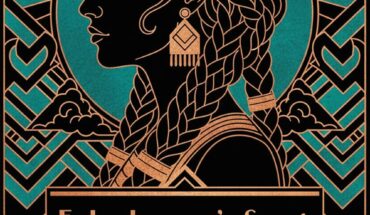
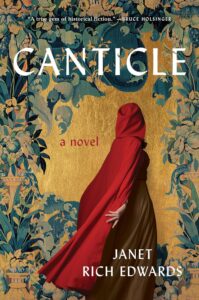
 What is a miracle? And who gets to decide? In 13th century Belgium, young Aleys attempts to forge a sacred life, but her journey from the common to the divine is plagued by political intrigue, scandal, and a power-hungry Church ruled by men. In Janet Rich Edwards’ gripping historical fiction debut, Canticle, she vividly brings to life a world on the verge of radical transformation. Grounded in the little-told stories of medieval women—mystics, saints, anchoresses, and beguines—the fast-paced plot sweeps us away on Aleys’ pilgrimage, as she experiences devotion, sacrifice, and the kinship of fiercely independent women.
Canticle is an Indie Next pick, Goodreads Readers’ Most Anticipated Books of fall, and one of Real Simple’s Best Books of 2025. Kirkus Reviews says, “In elegant prose, this deceptively quiet novel juggles big spiritual ideas with big social issues.”
I was privileged to read early versions of this brilliant novel. I loved it even then. It is smart, fascinating, and full of mystery and wonder—just like its author. When I finally got my hands on the final book, I couldn’t put it down again. Neither will you.
What inspired you to write Canticle? What was the spark?
I’ve always been fascinated by mystics, specifically, medieval mystics. For four centuries—roughly 1100 to 1500—there was a run of women who purported to speak directly with God (with whom I have a fickle and wary relationship, by the way, which might explain my fascination). In the midst of plague, war, famine and a Church hell-bent on power and punishment, these women delivered messages of love. Nothing but love. I was curious about their actual lives, since claiming a divine ‘showing’ was as likely to get you branded a heretic as it was a messenger of God. I asked myself, ‘what would a person who started getting these messages think?’ If they actually began performing what might be miracles, then what? I think they’d have some doubts. That curiosity was the spark for Canticle.
You obviously conducted a ton of research for this book. What were your best sources? How did you know when you’d done enough digging? And for those of us attempting to write historical fiction, do you have any advice on how to make history come alive as a compelling narrative?
Oh, so much research. God, I just love the research. You can get lost in the tunnels and not see light for days. I don’t know how anyone wrote historical fiction before Google and interlibrary loan. I consulted history books and academic papers and medieval reenactors for everything from the politics of Flanders in 1300 to the smell of raw wool to the metal buttons on a wedding dress. If you love your era, I’m not sure you’re ever done. I still turn up delicious tidbits. You pile all those goodies into your draft and then you have to pluck them out one by one so they don’t gum up your story. Michelle Hoover, my GrubStreet Novel Incubator instructor, told us to never let our research show. I also follow Hilary Mantel’s advice to remember that, despite their strange surroundings and even stranger beliefs, these were people just like us.
Your novel is about women’s independence, power politics, religious scandal, a world in upheaval…it sounds a bit like the world we live in today. When you wrote Canticle, did you expect to see so many parallels to modern society?
You’re right. Canticle is set in a world poised on the edge of radical change; for the first time, people were challenging an all-powerful and corrupt church. I wish I didn’t see so many parallels to today. But I also see hope. Canticle introduces readers to the beguines, women who banded together to form communities that refused the rule of the church – they’re arguably the first women’s movement. In writing them, I found unlikely heroes. It’s not just the radical and outspoken who make change. The silent bell ringer who smuggles illegal manuscripts, the maid who rewrites scripture so that it makes sense to women, are all part of a quiet resistance. It makes me feel better to think there are such masked heroes all around us now.
You are an epidemiologist by training, a scientist, yet you write so eloquently about mysticism, miracles, and faith. Can you talk about that seeming contradiction, if there is one?
Honestly, I think any good scientist has to admit that there are questions beyond the reach of our research methods. The dominant materialist paradigm we’ve had for centuries (read: only centuries) is itself a cult that disparages other ways of knowing. To me the scariest dystopia is one in which ChatGPT answers all our questions. Imagine a world without mystery. How dull would that be?
I understand you worked with an independent developmental editor before you sent Canticle out on submission. For writers who might be considering that option, why did you decide to go that route and what was the process like? Would you do it again?
When I finished the first full draft, I knew something was missing, but I couldn’t put my finger on it. I’d just read Lisa Cron’s Story Genius and saw that she offered consultations. I sent her Canticle. Lisa was absolutely brutal. She made me go through character rewrites–many iterations of them–perpetually asking ‘why?’ Why would she do that? Why would she believe that? Lisa’s ‘why’ was a sharp-bladed shovel that forced me to trace the taproot of my protagonist’s motivation. Yes, I’d do it again, in a heartbeat.
What was one “Dead Darling” you hated to cut from your novel and why?
I had one scene that I loved—too much to explain and it would make my novel sound like no fun—that involved Aleys removing a metaphorical crown of shame that she didn’t know she’d been wearing. It’s the last barrier between her and God. It was absolutely perfect and it absolutely didn’t fit in. I wrenched and tortured the story around to make that scene fit, but finally had to admit that it was actually the kernel of a different story.
I hear you were in England this past summer sleeping in churches and scoping out priest hidey-holes. What’s going on there? Is it research for your next book? Can you share a little bit about it?
Oh, this is the best part of historical fiction! The research can take you to medieval manors where you can squeeze behind moveable beams or skinny up chimneys to secret attics where renegade, illegal priests were hidden from Elizabethan authorities. I spent a couple nights ‘champing’ (church camping – it’s a real thing) in a 12th century church in a village in Norfolk, waking beneath a jewel-colored stained-glass window. I’m working up a story about a modern-day historian hot on the trail of the lost manuscript of the medieval anchoress Julian of Norwich. It might be a three-timeline plot, which I’m not sure I can pull off, but I’m excited to try. (And yes, it will include that dead darling!)
ABOUT THE AUTHOR
Janet Rich Edwards is a graduate of GrubStreet’s yearlong, MFA-level Novel Incubator program. A professor of epidemiology at Harvard, Janet wrote more than 300 papers for scientific journals, but was left wondering if she could convey more truth, or at least different truths, through story. Janet lives outside Boston with her husband and never more than two cats. When she’s not sneaking hours to write fiction, she’s researching facts about women’s health. Canticle is her first novel
Get your copy of Canticle now at Bookshop.org.