
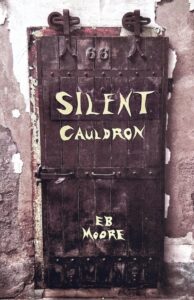
 EB Moore (Liz to her friends) has found artistic expression through sculpture, poetry, and as a novelist. Her first two novels, An Unseemly Wife and Stones in the Road are based on family history. Her third novel, Loose in the Bright Fantastic, was informed by her and her family’s joys and sorrows caring for her mother in her later years. Her new novel, Silent Cauldron, set in the 1830s tells the story of a young Quaker woman, Sam, who disguises herself as a boy to be able to work at a stable with her brother. She gets wrongly convicted of a crime and is imprisoned in the supposedly reformist Eastern State Penitentiary (at the time known as Cherry Hill Penitentiary), where she is known as Six. There she must fight for her sanity in the face of daily, dehumanizing treatment in solitary confinement until she finds a mysterious ally, Willa, who helps her plot her escape.
Laura: How did you come to pick this topic and write Silent Cauldron?
EB: When I went to my 50th high school reunion, which was outside Philadelphia, a friend of mine who is very involved in Nebraska prison reform said, “I’ve heard of this prison in Philadelphia that is now a museum, let’s go see it.” It was supposed to be Quaker inspired, it was meant to be a kinder, gentler place, so we went and we saw it, and I was so horrified by what we saw, I knew immediately that I would have to write about it. Then the research I did on it after that confirmed that absolutely I have to write something, but it needed to be a personal story about an individual, not just an historic overview, although it took me a long time to decide what that story was going to be.
Can you tell us a bit about Sam?
She was a girl who didn’t want to be what she was expected to be, particularly what her mother expected her to be – to wear the plain dresses that Quaker women wore, to behave properly, to get married, to have kids and stay at home and be a proper wife. She said, no, she liked the looks of what her brother was doing. He worked for a stable in an estate owned by a very rich family, although they were busily losing their money. She really wanted to work alongside her brother. She decided she would do what boys do and dress the way boys dressed. If people mistook her for a boy, so much the better. She wasn’t going to lie about it, because she didn’t lie, but she wasn’t going to help them understand her subterfuge. And she was very successful, because she knew horses, she learned very rapidly, so she was very successful at the stable, until she ran into a problem with the head of another family that had moved in nearby. The Kane family was new money, the father was rumored to be involved in the slave trade, and Sam got into a wrangle with the son, that eventually leads to her being imprisoned.
Sam was such a fully realized character. Do you have a conscious method for building a character and our relationship with her or does it just come naturally in the process of writing and rewriting.
Writing and rewriting makes a big difference. I tend to let my characters lead me. I have a notion of where the story is going, an overall plan with certain scenes I’ve figured out along the timeline. They’re not very detailed, maybe just three of four scenes to get me from one place to the next. But then, as I write the story, things sort of appear and I’ll take advantage of those things, and the character will lead me places I wasn’t expecting. That’s always fun, and I trust my characters.
The book is told in alternating timelines, opening with her arrival at the prison, and alternating with the story of her youth leading up to the conflict with the Kane family. The reader’s experience is obviously shaped by knowing at the outset that Sam ends up in this prison, so her early years, that held so much possibility for her, even within the constraints of the time, have a grim shadow hanging over them. Did you consider a chronological narration, or did you know from the outset that the two timelines served your purpose better?
I tend to do two timelines, starting the story at a crisis point, and going back to lead up to that crisis. I didn’t want to do it chronologically because I knew that I would need the story of her early life to be a kind of respite for the reader, because the book is so dark. What goes on in that prison is so very dark that there has to be some kind of relief for the reader and for me! I’ve had readers tell me that they have to take a break and put the book aside, but they come back to it because they want to know what happened. I know that it’s a very, very dark book. Going back to happier days…I enjoyed going back to that because, when I was young, I used to run a stable, and it’s a place I like to revisit. It’s fun for me.
Reading this book reminded me of reading Jesmyn Ward’s Sing Unburied Sing, which deals with the legacy of slavery in unsparing terms. As I did with her book and like some of your other readers, I had to put yours down periodically because of the visceral and vivid ways you bring Six’s experience to life and the harshness and unfairness of her circumstances. Yet I kept coming back because of the beautiful writing, as well as wanting to know what is going to happen to Sam. Was it difficult for you to write this book or did it reflect things you were grappling with anyway and it was a relief to get things on paper?
Actually, it was very helpful for me because at the time I was writing it, I’d just been diagnosed with pancreatic cancer, and we had gone into the shutdown for COVID. Where I live (in a continuing care facility), they really shut down completely, so we were all quite isolated. The combination of the two things at the same time was hard. One of the things that writing this book did for me was that when I was losing my hair from treatments, Sam/Six was losing her hair, so that I could feel what was going on with her. And I used a lot of what I was feeling from the (COVID) isolation I was in to flesh out her character. The great thing about it for me was that what she was going through was so horrifying that it made my life look fabulous. The possibility of my dying, I got that, but that possibility from illness is very different from knowing someone wants to intentionally kill you. It just made my life feel terrific. For me it was a real blessing. I know that’s bizarre, but it worked out very well for me.
The contrast between her childhood and youth and her situation at Cherry Hill, is heartbreaking. It’s a story of deprivation and disempowerment along so many dimensions. I don’t imagine you wrote this anticipating a second Trump administration, but reading this book now certainly lands differently than it would have under a Harris administration. Reading it, along with watching the first weeks of 2026 unfold, made me think on some level, ‘we’re all Sam now.’ Or am I being too facile?
Absolutely. I used Trump as my model for the slave trade father, Mr. Kane. Instead of having light hair that he dyed, he used bootblack on his hair. It was great to be able to use him as a model because he was so outrageous and, during that time, he was right in front of us all the time.
I think the title of the book is absolutely perfect. Was that the title from the outset or did you try other ones out?
That was the title from the get-go. It was such a cauldron. I was lucky with that. With some of my other books, my first two, I had to fight against the editor for my titles. My second two books were done with Frayed Edge Press, and they are just so good to work with. They’re responsive and thoughtful, amazing people. I’m thrilled with them.
You’ve written several historical novels. The first two were based on your own family history. I was wondering if you felt you had fewer constraints or more creative freedom with Silent Cauldron as it was inspired by a place and not a specific historical figure or set of events.
I very intentionally did not write the first two as documenting. I’d been told stories as a kid about what happened to my grandmother and great grandmother for the first novel and about my grandfather in the second one. So, the stories are real in that’s what I’d been told, but I expanded on or embellished them. I changed some things – I didn’t use the towns or cities that they ended up in, for example But I did do a lot of research and that was fun, including a car trip as close to the wagon trail as I could get, so that I could get a sense of the terrain they went through. I was appalled at the fact that a Conestoga wagon could get through that kind of terrain. It boggled my mind.
You were in the first Novel Incubator class and the first NI alum to be published. It’s particularly noteworthy because you are an older first-time author in an industry that has a bias toward promising young novelists. Can you say something about your publication journey and any advice for promising older first-time novelists.
I’ve got to tell you this story that doesn’t quite answer what you’re asking. I was writing under the name EB Moore, but my friends call me Liz and it got very complicated because at the time I lived in Cambridge, and there was another writer named Liz Moore who lived in Cambridge, who is now very, very popular. She was very young in comparison to me, and people would go to her readings (thinking it was mine) and say, “Who’s this young chippy here?” or come to mine and say, “Who’s this old crone.” I sometimes get excited messages because I’m in the New York Times, but no, it’s not me. I use EB because, when I was in my earlier career, I was a sculptor, and it was the same problem in that women and particularly young women didn’t work in metal. I was advised not to use a name that identified me immediately as a woman, and so I just used my initials. Having started that way, I continue to go by my initials. Also, I don’t like to put my picture on my books because, when I look at an author’s photograph it sometimes influences how I view the story, for some reason, and so I very carefully try not to look at it. Mostly I don’t have my picture on my books. But in the end, I write for myself, so I just don’t care.
I remember a story you once told that you were giving a reading, and a woman in the audience was disappointed because she bought your first book thinking it was an Amish romance, which you learned was a sub-genre in the Romance category.
That was a problem because the first book was slotted as an Amish genre book, and it’s just not. People who read it were horrified because there were all kinds of things in it that do not appear in that genre and they would send it back to the publisher and say, “This is not right!” and they were outraged. I was outraged that it was classified as an Amish genre book, because the marketing people clearly didn’t read it all the way through.
That raises something I didn’t think to ask about, which is the degree to which you have to supervise publication all the way through, given that the publisher (not Frayed Edge Press at the time) was pitching it inaccurately.
Absolutely! You have to be very careful all the way through, particularly in getting a cover, because in the beginning the cover they were trying to put on made it look like an Amish romance novel. I said, “No, no, no you can’t do that.” They made all kinds of mistakes, as well, such as putting buttons all down the front of the dress, but no buttons are allowed among the Amish. It was just silly, clearly the person doing the illustrating had no knowledge of the book.
Is there anything else you’d like to add? Just that the Novel Incubator was the best education I had, ever. I was very thrilled with it and continue to be. Michelle Hoover is spectacular and continues to be spectacular with all the things she does, such as the podcasts (7am Novelist). It was life changing, it really was.
E. B. Moore is a metal sculptor turned poet, turned novelist. She has been a resident at The MacDowell Colony, Yaddo, and The Vermont Studio Center. Publications: four novels, Silent Cauldron (Frayed Edge Press 2025), Loose in the Bright Fantastic ( 2023 from Frayed Edge Press), Stones in the Road (NAL/Penguin/Random House 2015, Kirkus starred review and named ‘One of the Best Books of 2015); An Unseemly Wife (NAL/Penguin 2014). A poetry chapbook, New Eden, A Legacy, (Finishing Line Press, ‘09). She lives in Scarborough Maine.


2 comments