
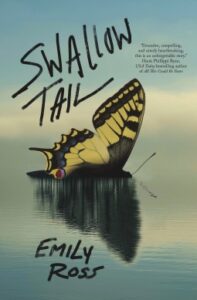
 Following up on her critically acclaimed novel Half in Love with Death, Emily Ross’s new mystery thriller Swallowtail (Galiot Press) transports us to Quincy, Massachusetts, where detective Samantha Star must confront her past trauma of a kidnapping to solve a new serial killer case that mirrors her own abduction as a teenager.
Publishers Weekly writes: “A Massachusetts detective investigates the possible reemergence of the serial killer she once escaped in this procedural. Ross maintains plenty of nerve-shredding tension … and makes her lead’s trauma palpable.”
Tessa Wegert, author of In the Bones says: “Emily Ross elevates the small-town murder mystery with complex female dynamics, a series of increasingly twisted crimes rooted in Greek mythology, and a New England community that bears scars. An artful exploration of trauma and obsession that delivers reveal after stunning reveal with narrative muscle and heart, SWALLOWTAIL is top-notch crime fiction.”
This novel which explores themes of trauma, art, and motherhood as Samantha races to stop the killer before her daughter becomes the next victim, is a suspenseful story perfect for fans of Mare of Easttown, and the work of Dennis Lehane. Emily took time out from her busy launch schedule to speak with me.
Marc Foster: Swallowtail opens with a terrifying flashback to the 1994 abduction and attempted murder that will shape the rest of protagonist Samantha Star’s life. Can you talk about the life choices Sam makes in response to that horrific crime?
Emily Ross: After that crime, Samantha turns to art to cope with what she can’t yet understand. But when her work draws the attention of someone claiming to be the killer, she abandons her artistic ambitions and joins the police force, believing it’s the only way to stop the person who shattered her life. Becoming a detective gives her a feeling of control over the unthinkable. But that control comes at a price, as her obsession with solving that terrible crime distances her from her family and leaves her feeling like an outsider. It’s a conundrum, because to be truly present for the people she loves, she must let go of her obsession, but she can’t do that until she understands what really happened on that night in her past.
Meanwhile, in the foreground, a local teen is found murdered in a manner similar to the 1994 crime. You artfully guide the reader, through Sam’s narration, toward an interrogation of whether this is a true copycat crime, with the same murderer, or not. How did you achieve a balance between disclosure and withholding in the opening pages?
In early drafts, I just tried to get the whole story out. Once I understood the mystery better, I went back to the beginning and made intentional decisions about what to withhold and what to reveal. Balancing those goals can be tricky. You don’t want readers to feel you are manipulating them by deliberately holding back information just to keep them guessing. What is withheld has to feel believable from the character’s perspective. I let Samantha guide those choices, based on what she would realistically be willing or able to share at any given moment. That required a lot of finessing and plenty of handwringing.
Sam’s position as an investigator on the Quincy police force conflicts with her role as mother of a teenage daughter – Corinne. Can you talk about the professional and personal tightrope Sam walks in her daily life?
Sam walks a fine line between being a good detective and a good mother. Having been a working mother myself, I know how it often feels like you’re not doing either job well. For Sam, the stakes are much higher. If she fails at her job, she may put her daughter in danger. But if she gives the case the attention it needs, she risks taking her eye off Corinne at a time when her daughter needs her most, and is potentially in harm’s way. There is no easy answer.
A similar tension exists in Samantha’s relationship with her newly-separated husband Jeff and her “work husband” and boss Brian. What choices did you make in writing those two support characters?
In earlier drafts of this novel, Sam and Jeff were unhappily married, mostly due to Sam’s obsession with the past. They argued a lot, and I found those scenes difficult to write. With help from my editor, Henriette Lazaridis at Galiot Press, I decided to begin the novel with Sam and Jeff already separated. Instead of arguing about whether to split up, they were figuring out whether they could find their way back to each other, and that felt more compelling.
I also leaned more into Jeff’s career in tech, and gave him his own obsession: a programming problem involving recursion—a type of function that, if not coded correctly, can result in an infinite loop. It mirrors Sam’s fixation on her trauma, and provides them with a shared point of connection.
Brian becomes Sam’s protector the moment he saves her from being kidnapped, and their shared obsession with solving the case unites rather than divides them. As the story evolved, I explored how witnessing what happened to Sam and Bridget shaped Brian’s life as well. He can’t forget it, and this, along with his own troubled past, gives him empathy for what she has been through. That mutual understanding becomes the foundation for their friendship, and their romantic feelings for each other.
The “old crime / new crime” sub-genre seems to have irresistible appeal for readers. Can you explain the attraction? What special opportunities and challenges did that form present to you in Swallowtail?
It’s a popular trope that adds layers of complexity to a mystery and can really put the squeeze on a detective with a personal connection to both crimes. I think a lot of readers are drawn to the idea that the present can be shaped by unresolved forces from the past. I’m particularly interested in the lingering effects of trauma, and I knew from the start that the violent crime in Sam’s past would cast a long shadow over her life, even though she couldn’t remember much of it.
That push and pull between past and present makes for a compelling mystery, but it also makes the book harder to write. Swallowtail was my first traditional mystery, and suddenly I wasn’t solving just one crime, but two. I also had to figure whether the crimes were connected, yet another puzzle to solve. I hit plenty of dead ends and had to rethink the story again and again, and that was painful! But ultimately that structure allowed me to explore how buried trauma resurfaces and demands to be confronted.
Misogyny and sexism are powerful through-lines in Swallowtail, along with the way those themes intersect with mythology. Did your understanding of misogyny evolve during this project, or did it reinforce what you already knew?
My understanding of misogyny didn’t fundamentally change while writing Swallowtail. But as I worked on the novel, I became increasingly aware of how closely the myths in Ovid’s Metamorphoses mirror the misogyny that still shapes our world today. Sam approaches these myths through the lens of her work as a police officer. The language may be poetic or imbued with magic, but the stories themselves aren’t all that different from the crimes she encounters every day.
Take the myth of Daphne: when she rejects the advances of Apollo, the god of the sun and a stand-in for any powerful man, Daphne is transformed into a tree. The transformation is described as beautiful, but she can no longer speak or move. That’s horrifying, and aligns with the lasting damage sexual violence can inflict on survivors, something we continue to see reflected in contemporary cases, including in the stories of victims from the Epstein files.
In another example, Sam views the myth of Persephone not as the romantic origin story of the goddess of spring, but as a parable of domestic violence. Like many abused women, Persephone is repeatedly drawn back to her abuser, in this case Hades, king of the dead. Seeing these myths through Sam’s eyes reinforced for me how enduring misogyny is, how long it has been part of our world, and how it continues to hide in the narratives that influence our lives.
Samantha has shelved her passion for visual art to pursue a career as an investigator, yet her eye for artistic detail pervades “Swallowtail.” How did you develop that aspect of her personality and skill set?
My father taught the Renaissance Workshop at the School of the Museum of Fine Arts, Boston and was an extraordinary artist in his own right. People came from all over the country to study mosaics, fresco, gold leaf, and classical painting techniques with him. My mother was a gifted portrait painter and illustrator, and my sister showed a remarkable talent for drawing from a young age. From the scent of turpentine that filled the air, to the paint splatters on the floor, art was part of my daily life, and that made it easy to give Samantha a strong artistic sensibility.
The challenge was integrating her artistic side believably with her identity as a detective. At first, I held back because I assumed she was too hard-boiled to be openly artistic. But I realized that was a stereotype. Police officers can be as creative as anyone else. Once I allowed Samantha to see the world through an artistic lens, it became central to how she solves crimes and opened up her character in new ways.
Which novels, films, and TV series did you keep in mind as you were drafting and revising Swallowtail?
When I hit Act Two in Swallowtail, I got completely stuck. I didn’t know how to move forward or how to solve the mystery I’d created. I turned to my son Tom, a producer and screenwriter with a great instinct for storytelling and the ability to tell you, sometimes bluntly, how to fix your story.
He told me to watch Se7en. “You’re writing a serial killer novel,” he said. “Se7en is an iconic serial killer film with a near-perfect screenplay. You should study both.” Although Se7en is one of the scariest movies I’ve ever seen, what struck me most wasn’t the shocking box at the end, but the final line of the movie when Detective Somerset says, “Ernest Hemingway once wrote, ‘The world is a fine place and worth fighting for.’ I agree with the second part.” Hearing this from someone who has witnessed the very worst in humanity moved me, and made me realize that even in the darkest thrillers, character matters most.
I also studied screenwriting rules, especially how the midpoint should be reversed at the end of Act Two, and trusted cinematic story structure to guide my revisions. It felt like a leap of faith, but those narrative rules helped me construct the escalating twists I needed to complete the novel.
What’s next?
Right now, I’m trying figure out a new idea for a mystery. I refuse to move forward until I know ‘the hook.’ At the same time, people in Quincy have been sharing stories with me about growing up there, especially stories involving Whitey Bulger. It’s not an exaggeration to say almost everyone who’s lived here a while has a story to tell about Whitey. I love listening to them and am intrigued to see where they might lead. If you have stories to share, don’t hesitate to reach out via my website: emilyrosswrites.com.
Emily Ross is the author of the mystery thriller Swallowtail (from Galiot press) and of the International Thriller Writers Awards finalist, Half in Love with Death. She won the Al Blanchard best story award for her short story, “Let the Chips Fall”, which appeared in Devil’s Snare: Best New England Crime Stories 2024. She is a graduate of Grub Street’s Novel Incubator. Swallowtail is set in Quincy, MA, where she lives her husband and Obi-Wan Kenobi, their very playful cat. Find out more on Instagram or at emilyrosswrites.com
She will be at Porter Square Books: Boston edition on January 27th 7pm, talking about Swallowtail with the fabulous Christine Murphy, author of Notes on Surviving the Fire! Find out more and RSVP here: https://portersquarebooks.com/event/2026-01-27/grubbie-debut-emily-ross-author-swallowtail-conversation-christine-murphy