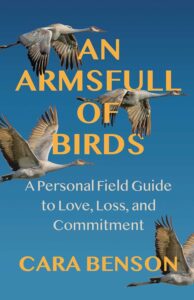
 Cara Benson’s An Armsfull of Birds: A Personal Field Guide to Love, Loss, and Commitment is a climate memoir that covers a sweep of experiences, including recovery, hiking and suicide. Even if these elements are not in your life, this book will feel familiar because it is so very honest and human. The author invites you like a friend into what she’s done and felt and known, creating an irresistible immediacy as you read about her mistakes, her fervor for nature, and her grief.
The book flew out into the world May 19, and arms full of readers are embracing it. Here’s some well-earned praise. “I opened it up to read the first few pages and then spent five hours reading the rest. Beautifully done. Poignant, human, authentic.” —Jenny Lawson, New York Times bestselling author of How To Be Okay When Nothing Is Okay
Amy: Your early publications and first book are poetry. What prompted you to write memoir?
Cara: Actually, I didn’t think I would ever write about myself so personally. And I never once imagined writing about losing Jon to suicide during the first years of acute grief. Then the COVID-19 lockdown hit, and I was walking in the woods every day to cope with, well, everything. This was so helpful for me, I thought I would write about it for others. So, I started a series for the Best American Poetry website called “Dispatches From A Distance” about these walks, and they seemed to resonate with readers. Lots of people were getting especially intimate on social media at that time. We were isolated, but in a way, we were isolated together. So, my series started taking on a more personal approach. At some point, it felt like I was intentionally resisting writing about Jon rather than feeling as if I couldn’t bring myself to do it. That’s when I knew I would write about what had happened, sooner or later.
What was it like writing such personal material, some of which clearly had to be painful to revisit?
I got to live with Jon again in these pages. I spent time remembering things he said, rooms we spent time in, the ways we touched each other. It was very vivid in my mind and in my heart. And writing about my own journey hitting a fairly scrappy bottom and getting clean and sober was interesting because I’ve been in recovery for over 30 years now. That feels like a whole lifetime ago, being that young, wounded woman who ran through subway tunnels and sold all her stuff on the sidewalks of NYC to get a drink. Bringing her to life again filled me with compassion and appreciation for how far I’ve come.
But when I got to writing about Jon’s death by suicide, I was a wreck. There were many days when I didn’t know if I could do it. One time it was so hard I got up from my computer and raced out the door into the woods, panting and nauseous and crying. Saying over and over again, “I can’t do this. I can’t do this.” I couldn’t wait to get to the part of my life where I let the woods heal me. Knowing that I’d survived, that my relationship with the birds and bear, the fox and coyotes who live behind my house was going to come into the story sustained me.
Your recovery from substance abuse is almost a setting for the book. You met Jon in this broad, abstract place, and you bring readers “in the rooms” of recovery meetings. Did you ever think of NOT locating the story here, of keeping the narrative focused on your intersections with nature?
Initially, I had no intention of including the addiction recovery storyline. The first versions of my writing about Jon’s death skirted the issue. I was being coy with my language, saying things that might tip the attentive reader off without overtly speaking to it. But to do the story justice, I needed to get as honest as I possibly could, so the fact that we’d met in recovery had to go in. That then begged the question of how much to include of what got me to needing to get sober, so in went some of my hitting bottom.
What kind of books, if any, did you read as you wrote this?
I’ve thought of Armsfull as a cross between Cheryl Strayed, Terry Tempest Williams, and Anne Lamott, so I was consulting their books, though not reading them, per se. The books on my bedstand were Sarah Polley’s Run Toward the Danger and a stack of my favorite guilty pleasure genre of mountaineering expeditions that go horribly wrong. The latter provided an escape for me, which I needed.
This book is more than just a recovery memoir or a book that deals with a suicide. It’s full of many themes – addiction, recovery, relationships, mental health, suicide, grief, nature, hiking, climate change – why did you choose to include these aspects in the story?
They are all connected for me. I couldn’t write about Jon without writing about the fact that we met in recovery. And I couldn’t write about recovery without writing about the fact that hiking mountains saved me from myself. And I couldn’t write about mountains without confronting the climate crisis and dealing with climate grief, which exacerbated my personal grief around losing Jon. And then Jon’s love of birds, and the line in my poem to him that gave me the title became an organizing principle for the book. His attention to his feathered friends was such a lesson for me on how to be on the planet – especially now. Learning that from him brought everything together for me, and so it all had to be in the book.
ARMSFULL uses an alternating timeline structure. One thread tells the story of the end of your addiction and the beginning of your recovery. The other tracks from first meeting Jon after you’d already gotten clean and sober. What moved you to go back and forth like this, and how did you determine how far back to go in telling the story?
I knew I needed to give the reader breaks from the heavy parts of the story. I didn’t know exactly how that was going to unfold, and it took me a long time of trying out different starting points to find the structure I settled on. Initially, the light and love and joy is in the Jon and me thread, and these chapters are the respite from some of the material of me hitting bottom and struggling in recovery with my mental health and with my mother’s cancer. At some point, the timelines converge, but even then, there is some back and forth in chronology, the way memory works, or dreams. Or the way revisiting previous events in our lives changes with the knowledge of the present, of what came after. It felt organic to the story to continue some fluidity with time.
Despite such serious topics, the book has a lot of humor in it. What was your process around choosing how to use humor in the story?
This would not have been an honest or true book if it didn’t have humor. Jon and I laughed so much together! As did my sister and me with my mother, even when she was in agony from ovarian cancer. And me with myself. I love how I can crack myself up. (My cats, not so much.) Being able to laugh when things fall apart has saved me on more than one occasion. So the book comes by its humor honestly. But I did want to pay attention to not using it as a distraction from the weightier issues the story is engaging with. I didn’t want to be flip. There were some really funny parts that I took out because they didn’t serve the bigger picture. They became my dead darlings.
Cara Benson’s stories, essays, and poems have been published in The New York Times, Boston Review, Orion, Sierra Magazine, Best American Poetry, The Brooklyn Rail, Fence, Hobart, Identity Theory, Poetry Society of America, and many other venues. Her first book, (made), is a hybrid micro prose/poem collection published by the Toronto indie publisher Book*hug. Cara has received a New York Foundation for the Arts Fellowship and a bpNichol Prize. She lives and writes in a former church in the ancestral homelands of the Mohicans.