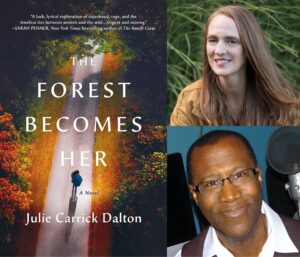
 In Julie Carrick Dalton’s new novel, The Forest Becomes Her, set in historic Concord, Massachusetts, a centuries-old forest has been removed to make way for a new, eco-friendly housing development. The locals are upset by the destruction, but out-of-towners like Hazel Stoddard are flocking to put down roots in their new guilt-free dream homes.
Soon, a tragedy leaves Hazel unmoored in her new life, and she begins to feel the pull of the absent forest. Hazel is not alone—her neighbors, real estate agent Stella Flint and teenage environmentalist Polly Bauer, each have their own traumas and their own relationship to the land. The three women join forces to save the last remaining oak tree, or risk losing themselves.
All knobby knees and elbows, with uneven pigtails whipping across her shoulders, Polly pumped her arms and sprinted the final stretch toward the old oak, the last remaining tree where a 400-year-old forest stood weeks earlier.
Cam: Every good book starts with an inciting incident. You were once traumatized by forest clear-cutting. Tell me about it.
Julie: I was the kid who played in the woods all the time and built forts. I really loved the forest behind my house. When I was a young teenager, the forest behind my house was clear-cut to build houses. I loved the whole forest, but I had this one tree with a vine that hung down, and I used to go sit on the vine and read. I read great books there, you know, Little Women, all my Judy Blume books, and some scandalous books I did not want my parents to see me reading.
It was really special to me, and it was torn down. Losing it felt like a death. I gave that wound to my character, Polly, in The Forest Becomes Her. I imagined her as a bolder, braver version of who I wish I’d been when I was 13.
In this, your third novel, three women are your protagonists. Is this autobiographical fiction?
This is the most personal thing I’ve ever written, maybe ever will write. Polly is 13, Hazel’s in her 30s, and Stella’s in her mid-50s, which I am right now. They’re versions of me at those ages. I had the idea of creating three versions of myself and making them live contemporaneously, interacting with each other. Imagine if you could have your past selves interact with your present self. I handed them a single problem: save the last tree after a forest is clear-cut, and they have to work together. It was exciting to imagine how different versions of myself would handle the same problem.
Your previous book, The Last Beekeeper, was about finding family. I would describe this more as characters finding connection. Do you see being connected as essential to wellness?
Good question. Yeah, I do. Connection comes in many forms: to family, to the land, to the place you’re from or where you live at that moment, to the soil, and to nature. In this book, a forest is clear-cut, and that loss breaks some connections. But at the same time, the land connects these three women because they need each other.
“How do you not feel that?” she asked him weeks earlier as she lay prone on the kitchen floor with her ear pressed to the wood.
I’ve read your three published novels, but here you’ve made a hard swerve by introducing magical realism and giving agency to the forest. To trees! What possessed you to be so bold?
All my books start with a what-if question. For The Forest Becomes Her, I asked, what if a forest haunted people instead of people haunting a forest? These women start to believe they’re being haunted by the forest. So many stories are so human-centric. What if the forest was in charge? Giving the forest agency and sentience gave it the power to fight back. Thinking back to my forest as a kid, I would have loved it if it fought back. When I was a kid, I believed in magic; I believed serendipity was possible. I still do. People say, Get back to nature, Go out in nature. Well, hello! We are nature.
As your protagonists, human and otherwise, become more connected, they become fiercer.
I love that word! At 56, I feel fiercer than ever. I’ve entered that I don’t give a **** phase of life, like Stella. As you age, you gain some wisdom looking back on your life, become more willing to cast aside what isn’t serving you, and seek out what is. You become better, fiercer.
Several characters—Stella included—flip from hurting nature to warring on its behalf.
I don’t agree with a lot of things that I did in my earlier life. I had such a different worldview then. I had four young kids at home. I was working as a journalist, trying to get through the day. I wasn’t thinking about the bigger world. Hazel’s kind of like that: new house, new husband, wants to have a family, and is just focused on her little world.
There are characters who make bad decisions, not necessarily motivated by evil, but making the best choice for them at the time. In hindsight, maybe not such a good choice. I think we’re all complex, doing our best in that moment. So I think it’s giving ourselves a little bit of grace to look at characters and see some redemptive potential.
Your books always teach me something scientific. Here, you mention trees communicating via fungi, also known as mycorrhizal networks, or colloquially as the Wood Wide Web.
I’ll give you a high level. When invasive beetles move into a forest, a tree releases a chemical to try to keep the beetle from boring into it. When the beetle attacks, the first tree doesn’t have a lot of defenses yet, but emitting this chemical alerts the other trees. They can start producing that chemical before the beetle reaches them, even though the first tree might be a goner. Or, when some trees are about to die, they shoot all their nutrients back into the ground through their roots as a parting gift to the other trees around them.
They’re sharing information through chemicals, not chatting with one another per se, but they are communicating. These networks of fungal structures under the ground and all these other little critters and bacteria, nematodes, create an information network. They transfer sugars, carbon, and nitrogen, and they move things—an underground transportation system. In the book, the whole forest is cut down except for this one old oak tree. That means its information system is cut off. If, all of a sudden, you were cut off from all the other humans around you, you’d be lonely. We need people to exist, for our emotional well-being, for survival, for our health and safety.
In wildness is the preservation of the world. – Henry David Thoreau
Concord, Massachusetts, was once home to great authors: Thoreau, Emerson, Hawthorne, and Louisa May Alcott. They were transcendentalists who believed in the concept of the “Over-Soul”. Why did you set this novel there?
I read The Over-Soul, by Ralph Waldo Emerson. It has this transcendental ideology of God existing in all of nature. Not that a tree is God, but God exists in the tree. They were also conservationists who valued our connections with nature. Concord is really big into conservation. Many residents, when they die, will their land to the town, so that it can’t be developed. They’re very protective of the land.
We’ve all heard about school boards being infiltrated by candidates who ban books. As a conservationist and environmentalist, I see us losing ground on many fronts, not just education and conservation. I imposed that model on a fictional land board in Concord. If the land board could be co-opted in a progressive town like Concord, Massachusetts, it could happen anywhere.
While some rail against books, science, and education as a great evil, we face epidemics of loneliness, isolation, and social media dependency. Can nature help us get past that?
Being in the dirt, having your hands in it, gardening, and doing yard work boost your mood. It isn’t just because you’re outside, being physically active, or working with someone else. The bacteria in the soil are good for your body, your health, your immune system, and your mood. Doing that on a regular basis improves our well-being and heightens our sense of awe.
You don’t think we cultivate sufficient awe?
That feeling of, like, going outside on a summer night and seeing the Big Dipper really sharply against a dark sky because you’re out somewhere without city lights is so awe-inspiring to me. When you can see the Milky Way. You don’t get moments like that by looking at a picture of the Big Dipper. And walking in the woods, being surrounded by trees. The crunch of things. The smells of decaying leaves, possibly putrid. The smell of a pine tree or flowers in bloom. All that sensory information has got to be good for your brain, right? There isn’t enough of it. We need to seek out awe more often.
As Joni Mitchell sang in Big Yellow Taxi, it’s a lot easier to “pave paradise and put up a parking lot” when we’ve lost our sense of awe.
I was with a group of teenagers at the Walden Woods Young Writers Workshop doing a workshop at the site of Thoreau’s house. I asked them to think of a place in nature that was special to them and remember what it smelled like, what it sounded like, the warmth, the cold, all the details, and why it mattered to them. Sit with why you loved it. And now, what’s your emotional response if someone says they’re going to destroy that? Someone’s going to take it. So you go love it, instead of waiting for something to be gone to then mourn it, like love it right now. Be aware of things you love and love them now. Don’t just walk by it every day—see it.
She sucked out the soil wedged under her thumbnail, rubbed the grit into her gums, and swallowed. Consuming the mossy, metallic loam made her feel part of the land, like her mother.
You seem the epitome of earthiness: you’ve been a farmer, and you spent your childhood in trees reading books. You depict characters working in the mud. I couldn’t help but think Julie is totally writing this from first-hand experience.
There’s a 50-50 chance every time you see me, I’ve got dirty fingernails. I make no apologies for that.
I once heard you describe yourself as a “tea witch”.
There’s a progression here. I used to be a beekeeper, then we moved. Toxic neighborhood pesticides killed off tens of thousands of my bees, which really devastated me. I no longer keep bees, but instead consider myself a bee ally. So I planted a pollinator garden with 2-3 dozen indigenous herbs, fruits, and edible flowers. I dehydrate them, and I make tea blends. Some of them are just tasty; others have a purpose. I make a Cough & Cold Tea, a digestive tea called Tummy Tea. I make Sleepy-Time Tea and a De-Stressing Tea. My most popular blend is called Menopausitivi-Tea, which is good for hormone balancing. So now I have this massive tea garden, and I grow a ton of tea. I hang herbs from the rafters to dry, and I have all these jars full of dried herbs all over. My husband jokes that I’m turning into a witch.
All you need is a little cauldron in the corner.
I have a real cauldron, believe it or not. It would probably take three grown men to lift it. It’s this wrought iron, ginormous cauldron that my grandparents and great-grandparents used to make apple butter over an open fire. The witchiest cauldron you’ve ever seen!
I heard you were just named a Scholar of Note?
I was selected to be a Scholar of Note at the American Library in Paris, which is incredibly exciting. I’m going to Paris for all of April, and they’re giving me an apartment that’s a 10-minute walk from the Eiffel Tower. I’ll have an office in the library and access to it all, as well as to experts in my field of research. It’s an incredible opportunity. And it’s Earth Month. Stop by and say hello if you’re in Paris in April of 2027. It’s going to be hopping!
What messages would you like readers to take away from The Forest Becomes Her?
There’s a lot of anger, grief, and fear about climate change and ecological destruction, which can lead to paralysis. Yes, absolutely mourn what’s disappearing. Be angry! Grieve! But if it ends there, your emotions won’t make a difference. Don’t just wait for the things you love to be destroyed—love them while they are here and protect them. Those trees in your yard are amazing. Plant a garden and be like, oh my God, that flower is gorgeous. Don’t only be mad. Don’t only grieve. Don’t only be afraid. Bring some joy and love and appreciation into it. And then take action.
Maybe a little fierceness, too.
Fierce appreciation. That’s what I want from everybody.
Any advice for budding writers?
Be really honest about why you’re writing your story. Whatever the reason, dig even deeper. Don’t just skim the surface.
I don’t quite understand what you mean. If I’m honest about why I’m writing this story, what will I find? What did you find?
I’ll give you an example. In The Forest Becomes Her, Hazel, when she’s in her 30s, moves into a community built on the site of an old forest that had been clear-cut for new development. When I was 30, my husband and I bought our first home on a piece of clear-cut land. It was a cookie-cutter house with no trees. I was over the moon! I’ve got a house; I’m starting a family. I didn’t think about the land or the ramifications of my decisions.
When I wrote Hazel’s character, I re-entered that time in my life and explored it. I had to get honest with myself and look at part of my life that I might do over differently. I found truth in my fiction by re-assessing past decisions, honoring how they made me who I am today, and giving my former self a little bit of grace, knowing that I’m still evolving. I’m not perfect. Hazel reflects a flawed, but honest version of me.
The Forest Becomes Her is the first novel in a two-book deal you received from St. Martin’s Press. Have you made any progress on book number four?
I’ll give you a mini-teaser: I finished the first draft three days ago. Its working title is Children of the Flood, set a couple of generations into the future in an Alaska that has seceded from the United States. It’s a climate-altered, free Alaskan nation. Five foods have gone extinct. A museum dedicates itself to preserving extinct foods and the cultural ties, memories, and emotions we have to foods that disappear. Thematically, it’s really about which memories we cherish, which we need to forget, and how we let them go. I was rushing to put it to bed before the tour for this book starts.
You’re on a roll, Honest Julie.
Well, thank you for reading and for the interview. I really appreciate it.
Julie Carrick Dalton is the New England-based author of The Last Beekeeper, longlisted for the Massachusetts Book Award, and Waiting for the Night Song, winner of the New Hampshire Writers’ Project’s People’s Choice Award for Best Novel, an Amazon Editor’s pick for Best Books of the Month, and a Most Anticipated 2021 novel by CNN, Newsweek, USA Today, Parade, and others. A member of the teaching faculty of Drexel University’s Creative Writing MFA Program and a recent Visiting Lecturer at Tufts University, Julie is a frequent speaker on the topic of Fiction in the Age of Climate Crisis at universities, conferences, libraries, and museums, nationally and internationally. Her writing has appeared in Chicago Review of Books, Orion, Newsweek, The Boston Globe, Electric Literature, Lit Hub, and other publications. Her third novel, The Forest Becomes Her, will be published by St. Martin’s Press in 2026. When she isn’t reading or writing, you can probably find Julie digging in her garden, skiing, kayaking, walking her dogs, or trying to keep track of her four adult children.
Find out more about Julie on her website, Instagram, Facebook, and Substack.