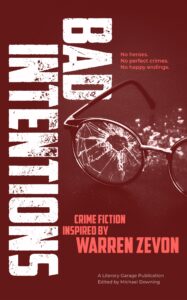
 Bad Intentions, Crime Fiction Inspired by the Music of Warren Zevon, edited by Michael Downing, packs a punch you won’t soon forget. Like Zevon’s iconic song “Lawyers, Guns and Money”, the short stories in Bad Intentions feature people caught in desperate situations who make bad decisions that spiral into painful consequences. But these nail-biting, anxiety-inducing, sometimes funny or heartrending, and always compelling stories don’t retell Zevon’s songs. Rather, they invoke their outlaw spirit in ways that will excite you even as they leave you unsettled.
All proceeds from Bad Intentions support Philabundance, a nonprofit food bank with a mission to drive hunger from our communities today and end hunger for good. It’s a great cause and one more reason you should grab a copy.
I was delighted to chat with Michael Downing, acclaimed crime fiction writer and editor of Bad Intentions, along with Zakariah Johnson, the highly praised author of genre-bending stories and a contributor to the anthology, about Zevon’s influence on this collection, the process for putting it together, and so much more.
Emily: I became a Warren Zevon fan back when I had my first tech job in the late 70s. I loved “Werewolves of London” and “Lawyers, Guns and Money” but at the time I never connected his music to crime stories. But now that I’m listening again, I can see it! What inspired you to build a collection around his songs?
Michael: That’s a great question because it mirrors the path many Zevon listeners have when it comes to his music. Start with the hits and then discover the storytelling.
I’ve always been a Zevon fan. My friends would probably say fanatic is more accurate….. I always felt Zevon was an underappreciated storyteller. His songs are literate, character-driven, and packed with memorable people. “Jeannie Needs a Shooter” is practically a crime novella. So are songs like “Lawyers, Guns and Money,” “Roland the Headless Thompson Gunner,” and “Play It All Night Long.”
One thing Zevon does exceptionally well is create characters who are both guilty and sympathetic. They’re flawed, often self-destructive, sometimes responsible for their own problems but you can’t help rooting for them. When you read Bad Intentions you’ll see that the best stories don’t retell Zevon songs. They capture that same spirit- smart, funny, damaged people making bad decisions and then trying to survive the consequences.
Emily: The stories in Bad Intentions vary in style and genre and this makes for a really engaging and surprising read. While all are broadly crime fiction, some are hard-edged or noir, others are funny or heart rending. They feature professional criminals, people struggling to survive, a musician who plays himself in a cover band, hired killers, small town cops, some Hollywood types, and more. Can you talk about what they may or may not have in common and your process for choosing and organizing the stories in this collection?
Michael: I wasn’t looking for the best Warren Zevon references. I was looking for stories that captured the spirit of his work. The strongest submissions gave memorable characters, authentic emotion, dark humor, and that unmistakable feeling that one bad decision could change everything. I wanted fifteen stories that worked together as a collection too. A great anthology is more than fifteen good stories…it’s fifteen stories that create something larger when placed side by side, so the challenge wasn’t finding fifteen good stories. It was finding fifteen stories that could sit together without sounding alike. What made the process difficult was that some excellent stories didn’t make it into the anthology through no fault of the writing. Sometimes it came down to tone, pacing, or how the story fit within the larger collection.
One of the most interesting challenges was building the sequence. I wanted the anthology to have momentum, variety, and emotional range while maintaining a consistent tone. In the end, I think we assembled a collection that captures many of the qualities that made Zevon a remarkable storyteller: flawed people, difficult choices, and consequences that aren’t always what we expect.
Emily: Zakariah, your story “Bad Road, Wretched Road”, which shares a title with a Warren Zevon song, opens with a white-knuckle scene in a speeding car that I can’t get out of my head. This story, which spans many years, has an intriguing speculative aspect as well, and is compelling from beginning to end. I’m curious about the role that the title song plays in this story and how this unique crime story came together for you.
Zakariah: Thanks, Emily! The kernel of this story was planted by a vindictive police execution committed when I was living in a tiny Appalachian town—barely a village—which anyone who’s from there will recognize. True to form and Zevon’s worldview, the powers that be evaded legal repercussions, but for once, just once, their affrontery sparked a sustained, local uprising. My story examines how that might have played out long term.
The speculative aspect is inspired by the source material: Zevon’s “Bad Road, Wretched Road” is one of two his songs that debuted on the 1992 episode of Tales from the Crypt titled “King of the Road,” which stars Brad Pitt as a drag-racing hoodlum. The first song “Roll with the Punches” appeared on Zevon’s masterful I’ll Sleep When I’m Dead album. But the song that really grabs you while watching the show is this secret hit: a gritty, unacknowledged track with the repeating lyrics, “Bad road, wretched road…” sandwiched between a stream of gravel-throated, testosterone-addled sexual boasts. That refrain has been bouncing around my brain like an angry bee ever since! The song can be heard in the background playing on the radio in Pitt’s car while he drives and, to my knowledge, was never released elsewhere. In my story—which bears no relationship to the TFTC episode—I sought to evoke the reckless, fatalistic dissonance of that riff alongside the moral clarity and comeuppances we could always count on the camp classic show and Zevon himself to deliver.
Emily: “Bad Road, Wretched Road” spans around a decade and has a cast of fascinating characters I’d gladly spend more time with. Have you given any thought to expanding this into a novel?
Zakariah: Ha! Thank you! That’s a comment I get asked a lot: “This short story is so complex, have you considered a novel?” I do write complicated plots, and I got attached to these characters after spending so much time with them, so it’s possible I’ll double back to see what they’re up to.
Emily: Many of the characters in this collection are driven into desperate situations by systems that have failed them. For example, Joel Nedecky’s sharply observed and riveting “Oil in the Bones” keeps its finger on the pulse of a flawed man who, in the face of a cruel bureaucratic reality, makes a risky decision to save someone he loves. I can feel his anxiety and the anxiety of many of these characters as they wrestle with the high-stakes decisions they feel compelled to make. Can you talk about the undercurrent of social commentary that runs through Bad Intentions?
Michael: The anthology was never intended to make a political statement. But many of the stories naturally touch on issues like economic insecurity, addiction, healthcare, bureaucracy, and the kinds of systems that shape people’s lives. What interested me wasn’t politics as much as pressure. Most of these characters are under tremendous pressure. Some are trying to get ahead. Many are simply trying to break even. They’re one bad break, one medical bill, one mistake, or one piece of bad luck away from disaster.
That’s very much Zevon’s world. His songs are filled with people hanging on by their fingernails. Sometimes they’re victims of circumstance. Sometimes they’re victims of their own decisions. Usually they’re a little of both.
One of his great strengths was recognizing that life isn’t always fair. Whether it’s the dark humor of “My Shit’s Fucked Up” or the heartbreak of “Reconsider Me,” he understood how quickly life can change. I think many of the writers in this anthology capture that same reality.
Emily: The endings of short stories can make or break them and these stories have some great ones. They’re dark with occasional glimmers of hope and humor and they often come with an artful twist. The ending of Whiskey Levins’ “Boom Boom Mancini”, the story of a boxer who gets drawn into a bad situation, completely surprised me in a good way. What do you think makes for a good ending to a short story?
Michael: One of the things that interests me most in crime fiction isn’t necessarily the crime—it’s the consequence. The crime is often the easy part. Living with it is where the story begins.
The endings that stay with me are the ones where the reader understands exactly why a character arrived at that moment or that choice, even if they wish the character had made a different choice.
Life is messy and dirty and rarely wraps up neatly. Neither does crime fiction. The best endings feel both surprising and inevitable. You didn’t see them coming, but once they show up, you can’t imagine the story ending any other way.
Emily: How did you come up with Bad Intentions for the title?
Michael: Originally I was playing around with variations of “Lawyers, Guns, and Money” because there’s no better crime story title than that one. One version was “Lawyers, Guns and Bad Intentions”. Eventually I shortened it to simply “Bad Intentions” which sums up the stories and the characters within the anthology. It captures one of the central themes: people who know better and do the wrong thing anyway.
Zevon’s songs are filled with people acting on bad impulses, poor judgment, desperation, greed, lust, pride, revenge, or simple recklessness. In other words, they have bad intentions, or at least intentions that lead somewhere bad.
The title felt like it belonged to both Zevon’s world and the world of crime fiction. Once we landed on it, nothing else seemed right.
Emily: Michael and Zakariah, what’s one piece of advice each of you would give to writers about writing short crime fiction?
Michael: Don’t start with the crime, start with the character. If you start with the crime and forget about the character, all you get in the end is a police report. Nobody wants to read a police report, not even cops.
Zakariah: Write the stories you’re compelled to write, the stories that excite you and drive you emotionally. If you’re bouncing out of your seat while you’re writing your first draft, you’ve got something.
Emily: What are each of you working on now?
Michael: Right now I have a new book scheduled for release this Fall entitled “The Weight of What Remains.” Set during a brutal Atlantic City gang war, the novel follows Twist, a gang leader whose attempt to broker peace through a hostage exchange spirals out of control in ways he never expects. Part crime novel and part moral reckoning, the story explores loyalty, guilt, sacrifice, and the heavy cost of the choices we make when there are no good options left.
I also have some short stories that will pop up over the next few months, including one in a crime fiction anthology Day Dream Believer based on The Monkees songs called “Goin’ Down”.
Zakariah: As you suggested I should do, I’m working on a novel that grew out of another short story. In the course of writing the book, I’ve created some scenes that didn’t end up fitting the narrative, so I converted those into short stories starring the same characters. One of these side-quest adventures will appear this fall in Death Camas: Best New England Crime Stories 2026 and another in a Cowboy Jamboree anthology about the same time. After publishing crime fiction for over a decade, I’ve finally got my “crew” together whom I can hang with for the next ten years.
Emily: What are your favorite Warren Zevon songs?
Michael: I can easily name a dozen songs that I play repeatedly, but my favorite hands down is “Accidentally Like a Martyr”. A lot of my own writing revolves around regret, missed opportunities, second chances, and people trying to come to grips with the consequences of their choices. That song drips with that kind of emotion.
Zakariah: “Bad Road, Wretched Road” is hands down my number one, an earworm I’ll never excise, or want to. Among his released hits, I’m a sucker for “Roland the Headless Thompson Gunner,” the B side on the 45 with “Werewolves of London.” It’s mind blowing anyone could write a song at once so obscure and erudite, yet so accessible. Zevon continues to set the benchmark for musicians and storytellers alike.
Michael Downing is a writer originally from New Jersey and now living in Georgia. His latest novel, Saints of the Asphalt, was released in 2025, and his next book, The Weight of What Remains, is scheduled for publication in Fall 2026. Over the past twenty years he has written plays, published several books, and seen his short fiction appear in numerous literary magazines and anthologies. His work has been nominated for the Pushcart Prize three times.
He lives northeast of Atlanta with his wife Helen but remains unmistakably New Jersey—attitude, edginess, and Springsteen songs (just not Bon Jovi).
Zakariah Johnson plucks banjos and pens genre fiction on the banks of the Piscataqua. A member of the Short Mystery Fiction Society, he has been a reader for both the Derringer and the Al Blanchard awards and contributed a regular column to Mystery Tribune. Among his publications are Mink: Skinning Time in Wisconsin, a murder mystery set during the ’90s blood feud between Midwestern fur farmers and the Animal Liberation Front, and the mixed-genre short-story collection Egg on Her Face. Learn more and follow him at ZakariahJohnson.com.