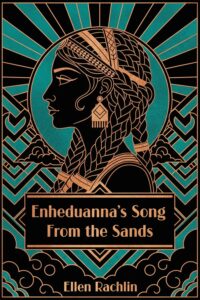
 A high priestess dethroned. A rebel with a dangerous plan. An empire hanging by a thread. Ellen Rachlin’s debut historical novel, Enheduanna’s Song From the Sands (Histria Fiction, 2026), draws on history and myth, as it recounts the story of Enheduanna—the world’s first named author—as she navigates power, betrayal, and divine destiny in ancient Mesopotamia.
When Enheduanna is named High Priestess of Ur, her connection to the gods makes her a target. A coup strips her of robes, power, and home, casting her into the perilous underworld. There, amid forests of shadows and treacherous trials, she discovers that divine favor alone won’t save her—only cunning, courage, and a willingness to embrace the ruthlessness of her enemies can help her reclaim her voice and her power.
D. H. Haddad: I loved studying ancient Near Eastern archaeology and Akkadian language and literature, as a part of my ancestral heritage. What sparked your interest in Enheduanna and compelled you to write her story from a first-person POV?
Ellen Rachlin: It’s an amazing cultural inheritance! I first encountered Enheduanna through her father, Sargon the Great, the world’s first emperor. When I looked at his descendants, I noticed that he had four sons, two of whom succeeded him relatively briefly as kings. Then I noticed he had a daughter, who was a High Priestess of Ur. She was also described as the world’s first named author. This was incredible to me. I wondered why I had never heard her name. Almost no one I knew had heard of her either at that time, which was about seven years ago.
Of course, I had to read the works attributed to her (in translation) and found them compelling and powerful, like mythology. But one in particular, The Exaltation of Inanna, I couldn’t forget. It was a narrative hymn that told the story of Enheduanna’s exile from the city of Ur and her temple at the hands of a rebel king. The trauma left her without a voice. The story ends in triumph as Inanna, the Queen of the Heavens, comes to her one night. Enheduanna finds her voice again and is ultimately restored to her temple. So we inherited this hymn, and I couldn’t stop thinking about the story behind it.
Then I saw pictures of what remains of the partially restored Temple of Ur, Enheduanna’s temple, where she led her followers, communicated to the gods on their behalf, and managed vast property. It is on the outskirts of modern-day Nasiriyah, surrounded by desert. I imagined what it looked like in her day, when the Euphrates tributaries transformed that same land into lush marshlands and farmland.
The voice in The Exaltation of Inanna is urgently immediate, and in the first person. That influenced me to write her story also in the first person and in the present tense. The present tense can sound jarring, but I wanted to bring the past forward. The history is ancient, but her fears, fierceness, and spirit are not.
DH: After the brief prologue in Enheduanna’s first-person point of view as an adult and high priestess, she begins telling the long saga of her father Sargon Adad’s rise to power in the third person. Why did you make the bold choice to delay Enheduanna’s story and focus on her more famous father?
ER: This was another risky choice. All of Enheduanna’s struggles were a direct result of the way her father lived, the choices he made, and the enemies he created. The trauma was multigenerational. I felt her story needed to begin with Sargon, and that his rise to power was best told linearly rather than broken up into flashbacks within Enheduanna’s story. The novel follows her from early adulthood through the aftermath of her exile, so Sargon’s story provides the context for understanding her life.
And it helps that Sargon’s story, which I based on the Legend of Sargon, is fabulous, from his being placed in a basket in the river as a baby to his visions of Inanna and his establishment of the kingdom of Akkad. His story is told in the third person, from his point of view, which I wanted to contrast with Enheduanna’s first-person narrative.
Enheduanna is tough to love for much of the novel. I wanted readers to ask themselves what they would do in her place rather than distance themselves from her. I wanted them to admire her, even root for her, while recognizing her flaws. To complicate their view of her, I also use the points of view of people around her, who see her in different ways: as a victim, for example, or as a friend.
DH: What sort of research did you do in the archaeology and material culture of ancient Mesopotamia, especially the Sumerian and Akkadian cultures, which seem so vividly portrayed in your narrative? And what is an interesting thing you learned that you’d tell everyone you meet at a party or book festival?
ER: I spent months reading everything I could find electronically, and I acquired a small library. This period has a fraction of the background materials available for other ancient worlds. Not being a scholar or having formally studied the time period presented formidable barriers. Much of the writing was geared toward academics, so working through it took time, but I decided to lean into that.
I looked at artifacts online and in person at different museums to get a better feel for what was valued in that time. Seeing the gorgeous restored Enheduanna disk was a pivotal moment for me. She came to life. When I had gone as far as I could on my own, I reached out to scholars.
The big hook I use when talking to people is to ask whether they knew that the world’s first named author was a woman. I tell them that she is the first identifiable literary “I” and that readers and authors owe a debt to her for that. I also tell people about the many other “firsts” of ancient Mesopotamia beyond literature and writing.
DH: This is historical fiction, but in what ways have you deviated from the historical accounts, added characters and events, or even went against historians’ assumptions about Enheduanna’s life and times?
It was difficult taking a side on her authorship. Her life was extraordinary enough without my having the character be the true author of the works attributed to her. There is some compelling evidence in favor of her authorship, including a seal dating to her lifetime which depicts one of the hymns attributed to her. But none of the surviving copies of those works dates to her lifetime. So we don’t know and I respect the opinions on both sides of the authorship argument. For the purposes of the novel, however, I made the works hers. That may not sit well with some Assyriologists, but historical fiction sometimes requires making choices where the historical record leaves questions unanswered.
I also incorporated elements of fantasy in the underworld scenes. I was inspired by the myth of Inanna’s Descent where she descends to the underworld with the intention of stealing the Queen of the Underworld, Ereshkigal’s powers. In my novel, the underworld becomes a place where Enheduanna can learn to understand and wield power over humankind, something she desperately needs to know.
Ultimately, we know very little about Enheduanna’s life beyond her existence, her lineage, her role as High Priestess, the identities of some of her attendants, and the great works of literature attributed to her. I had to imagine much of her life, drawing on a mixture of historical figures, including her mother, father, attendants whose names we know, and her enemy, Yahatti, while also adding many characters of my own invention, such as Shulpac. Beyond those historical foundations, I used my imagination, drawing on the myths, legends, and archaeological evidence of the period to bring her world and her story to life.
DH: What were the biggest challenges and rewards in bridging the gap between your protagonist, who lived in west Asia over 4,000 years ago, and your modern audience? Did it help adding those memories and characters from Enheduanna’s school days, like her bully Shulpac who pops back up in her life as adults?
ER: Yes! Although Enheduanna’s circumstances as a powerful ancient High Priestess had to be imagined and may not be immediately relatable, her emotional experience is very relevant today. She was a woman who experienced betrayal in the face of her own loyalty and had to pay debts she hadn’t accrued herself. Her own brothers used her, and her chief enemy, Shulpac (Lugalanne), represented a multigenerational vendetta rooted in her father’s past.
I think many people can relate to how much of their struggles, both good and bad, are shaped by the circumstances they’re born into and the consequences those circumstances create. Adding memories from Enheduanna’s school days helped me show how those early experiences and relationships followed her into adulthood. While few of us have foes from the schoolyard or workplace who literally follow us through life, they can haunt us, nonetheless.
The reward is discovering that, despite the enormous distance in time and culture, her emotional struggles can still resonate with readers today.
DH: The first time we see Enheduanna writing is after she has a vision of the gods and underworld, while passed out in a dark cell. How do you connect her trauma and character growth with her need to write her own story?
ER: She is a writer by instinct, but she doesn’t relate to that side of herself. She is consumed with trying to convince her brother to appoint her as High Priestess, learning to become a High Priestess, and then maintaining her power and influence as a religious leader. It is only after she fails that she embraces her gift as a writer.
While she is kidnapped, she is powerless. At that point, writing is an un-fostered talent, but an instinct, nevertheless. When everything and everyone fail her, she turns to writing for comfort. Her instinct to write emerges again when she needs help and later, in exile, when she needs hope. It is something she did in childhood for amusement, but she never appreciates its power until she has failed at her greatest ambition. In discovering her voice and power as a writer, she finds what she has been seeking all along: a way to be an effective leader for her followers.
I think the possibility of transformation is what gives us hope. This is an especially powerful belief when we have failed at something or when something we love has reached its natural ending point. I think readers will relate to exploring their own gifts as a way to navigate the world.
DH: I’d love to hear more about how you wove together the gender/sexual, religious, and military politics more and more the deeper you get into the novel, without making it feel too modern. Even Enheduanna’s bisexuality felt grounded in the character and her beliefs.
ER: Most of those themes are surprisingly timeless. Unfortunately, gender politics is something we can’t seem to shake, along with the competition for power. Enheduanna’s transformation is the story, and the circumstances that brought her to that point were extreme. I hope that she inspires readers. In real life, the fact that scribal schools used the works attributed to her to teach generations of students makes her remarkable. A male tradition chose to honor her not only as a high priestess but also as a writer.
However, the world in which Enheduanna lived was, of course, very different from ours. While her emotions should resonate with modern readers, her agency was shaped by the life and culture that surrounded her. The ancient Mesopotamian world is not as widely known or taught as ancient Greece and Rome, and I worried that her world would seem too foreign to modern readers. That is part of the reason I chose to write in the present tense. I needed to bring that history forward. One parallel with modern times is the way gender and sexual politics can divide us from one another.
Mythology heavily influenced the narrative. Through it, I kept encountering ideas about gender and sexual identity that went beyond the binary focus prevalent in modern times. These ideas informed my choices for the characters. Although such identities were present in the cultural norms, I imagined that they were not universally accepted and could be a source of divisiveness. I made them part of the conflict.
I wish ancient Mesopotamia were better known. We owe a lot to this civilization. Aside from being the birthplace of literature and writing, it was also the birthplace of schools, government, and so much more.
ABOUT THE AUTHOR:
Ellen Rachlin is the author of five collections of poetry: At the Big Bang Resort, Permeable Divide, and Until Crazy Catches Me, as well as two chapbooks: Captive to Residue and Waiting for Here. She is the winner of the IBPA Book Award Silver Medal and has been a finalist for other awards. Rachlin currently serves as treasurer of the Poetry Society of America.