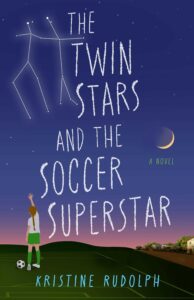
 How does grief shape us? In Kristine Rudolph’s emotionally layered middle grade debut, The Twin Stars and the Soccer Superstar, she vividly explores a young girl’s journey toward understanding how adults, parents, and children manage pain differently. Anchored in a mystery surrounding a local high school standout, this well-paced story details Cassaty’s experiences with the healing powers of friendship, community, and the realization that “perfect” does not exist.
An excellent addition to your child’s (and your own) summer reading list, Kirkus Reviews says it’s “a taut mystery fueled by its well-drawn characters’ self-reflection and emotional depth.”
I had the privilege of reading this novel right before it arrived in stores, and loved it. Full of gorgeous imagery and suspenseful twists and turns, this teacher calls it a must read over vacation!
Jen Johnson: What inspired you to write The Twin Stars and the Soccer Superstar?
Kristine: I have three children and one summer, my older child had an assignment where she had to fill out a reading bingo card and read one book of many different genres. One of them had to be sports related. I remember going to the bookstore, this was before Laurie Morrison and before Jen Bishop, and not one of those books would have passed the Bechdel Test. The main characters either had a crush on their coach or primarily focused on some other romantic interest and I remember thinking, this is not okay. That was the first driver.
Also, I was going to a lot of soccer games with my children. I did not push my son into team sports, but I made darn sure my girls were in positions where they had to collaborate, where they had to lose, where they had to fiercely compete against friends and then figure out how to be friends afterwards. I have so much respect for what team sports give to girls. I came into my kids soccer journey with that in mind, that involvement in sports is about development and growth. It was always top of mind for me.
Next, when my middle child, who’s my oldest daughter, started middle school, I saw how she watched the older girls and the players from the U.S. women’s national soccer team. I saw how social media was putting people on a kind of pedestal, a place that makes individuals not real people. This made me think a lot about the kinds of characters I was writing and how they might respond to this kind of situation. In my book, Katey, the star, the character who came to me first, is perceived as almost not being a real person. I knew a twelve-year old would think she’s perfect, and my character Cassaty was designed to be the reflection of Katey’s online persona.
For many years, I engaged with middle school readers and their parents once a month in a book club with my children and theirs, exploring books and hearing what seemed strange to them, what seemed interesting, what they understood and what they missed. I kept them in mind and I wrote this book for those kinds of kids, the kids who were in the book clubs, the kids who feel big things and maybe can’t really talk about those big things. These are the kids who are going to grab a book, feel the feelings on the pages and then maybe be able to articulate their own feelings a little bit more. I have a very strong respect for child readers. It is very important to me that we engage with them in an authentic, honest, respectful way, and with the understanding that these kids can meet us where they are developmentally. I believe fiction is a way to process emotions, and at the time I started thinking about writing, I felt there was nothing out there for them.
Cassaty’s twin brother died shortly after birth, and her mother struggles with his death every spring, every birthday of hers. This loss is always playing in the background for Cassaty and it is an enormous burden for her.
There’s a mental health through line in the book that’s complicated. A pivotal moment in Cassaty’s world comes when she discovers things are bigger than, oh, mom gets sad in the spring. There’s this moment when Amelia, Cassaty’s big sister, talks about seeing a therapist, where Cassaty comes to understand more fully all those times her dad showed up for her over the course of her life with a big smile and her mom wasn’t there, even if she said she was going to be there. The family eventually begins to discuss what happened to Cassaty’s grandfather and we can understand why the dad wants to paper over everything.
Cassaty is different at the end of the novel than she is at the beginning. She needed to be a big part of finding Katey in order for her to initially think, okay, I’ve done it. Everything’s fine now because I’m a hero. We see her realize, oh, wait, everything’s not fine. She had to be a part of that experience because it was necessary for her growth.
You did not include many physical descriptions of your characters in this book.
I attend the Broadleaf Writers Conference every September in Atlanta. Zach Steele, the founder and executive director, a very special human who believes so much in community for writers, finds the most amazing speakers who come, giving attendees direct access to some of the South’s greatest writers. I’ve had amazing conversations with Mary Kay Andrews, Nic Stone, Angie Thomas, Julian Winters–fantastic people. It’s an embarrassment of riches and I always learn something. One time I attended, I can’t remember who said it, someone talked about letting go of the need to fully physically describe your character. That was so powerful to me, because, first of all, you know, it doesn’t matter. The physical description doesn’t matter unless it does, unless there’s a tattoo or something that is crucial to the plot. It was another way I learned to trust the reader, trust your reader to develop their own ideas of a character. It gives them the space to engage with your fiction. That idea has freed me up a lot.
The setting in your book is beautiful.
When I was eight, my aunt and uncle got married, and that was the first time I had been to this part of Texas. The area was just magical from a little girl’s eyes. After that, we went back every summer. I started going to summer camp in that area, a little more west of Austin, north of Fredericksburg, so that area does represent childhood magic to me. A lot of people have this vision of Texas as being this flat plains kind of place. I remember the first time I went to Tuscany, I was in high school, and I thought how much it looks like the hill country. It’s really beautiful. I’m glad that spoke to you because it is a really important part of the book for me.
Can you tell me about your writing process? Are you a plotter or a pantser?
I’m a very linear writer. When I first started writing, I did things differently. Now, I definitely develop an outline for every book because I need to know the rise and the fall and the resolution ahead of time. This allows me to give myself the space to let the characters form and develop, and then I do family trees and character sketches for each character to make sure I’m consistent. But, I always have the outline next to me, and sometimes I will revise that outline, but not usually, because I know what the third act is going to look like and how I’m going to get there. It’s just the details I sometimes change.
Over time, I learned that we have a creative brain and a critical brain, and they don’t always play well together on the playground, right? So, now I take a sand castle approach, which is like, get that first draft, get all that sand, gather it up, build it up high, and then I go in and make it pretty. That outline is part of that gathering of the sand and then I take my first pass and correct things, like a glaring spelling error, that kind of stuff. But, I won’t do anything critical once I’ve made that outline.
In keeping with our blog name, was there a darling you had to kill when you were working on this book?
There wasn’t anybody that I wrote in and then had to take out. But, there were decisions about how big a character would be, how crucial to the storyline the character would be. I realized I needed Aunt Melodie to have her single focus be on the family so I did not want to bring her wife there. And, when I was thinking about Katey’s family, in the first chapter, we talk about Jack Korey, and then you really don’t hear about Jack Korey. You may hear about him, but you never really meet Jack. He’s just kind of there in places. I realized I did not want to put him in the mix at all. So, I guess I didn’t kill anyone. I just kind of bound and gagged them.
What is your big hope for the book?
Honestly, I can’t wait for it to get in the hands of readers so I can have conversations with kids about it. That’s been my dream all along.
ABOUT THE AUTHOR
Kristine Rudolph lives in Atlanta, Georgia, and Austin, Texas. She earned a BA in history and religious studies at Southern Methodist University, a JD from The University of Texas at Austin School of Law, and a Graduate Certificate in Children’s Literature from Pennsylvania State University. She is a member of the Atlanta Writers Club, the Broadleaf Writers Association, SCBWI, and the Children’s Literature Assembly of NCTE. She’s a Girl Scout troop leader and CASA/GAL volunteer. Learn more about Kristine and read her blog about parenting through transition at kristinerudolph.com.