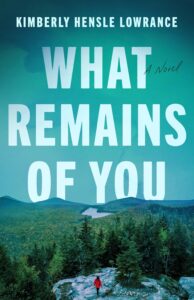
 A woman and mother struggling with the loss of her husband is catapulted back to the days and years prior to his death when she discovers a letter from him with a confession and a warning: he committed a crime as a teenager that may come back to haunt her and the kids the same way it haunted him. What Remains of You (Lake Union, July 1, 2026) is the astounding debut novel from Kimberly Hensle Lowrance. Hank Phillippi Ryan calls What Remains of You “Emotionally wrenching, heartbreakingly insightful, and gorgeously written” and “a total-immersion exploration into love, marriage, responsibility… and redemption.”
I was thrilled to have the opportunity to ask Kimberly a few questions about the novel and themes of trust and secrecy and the process of grieving.
Susan Donovan Bernhard: Kimberly, what a compelling novel! Can you share the origin story for What Remains of You?
Kimberly Hensle Lowrance: The first spark of What Remains of You came from a conversation with my husband. He and I had very different ways of processing our work days: I’d come home and download every detail, every conversation, everything that happened, while my husband would give me the bare outline of his day. Only later I’d learn something important had occurred; he just caught up in the nighttime routine with dinner and our kids’ bedtimes and forgot to tell me. I started to wonder what it would be like if a husband was actively keeping information from his wife. That sounded like a great idea for a novel!
I then paired two ideas: What would happen to a marriage if a person kept a big, life-changing secret from their spouse? And how are we changed by grief? I always like novels that wrestle with complex questions; I like how they ground the story and give it weight.
SDB: This is a domestic mystery but also a story of navigating grief. I found the writing in so many places incredibly tender, especially for a novel that has a mystery at its core. For instance, there’s a scene Diana recalls when she and Tom go to a bar after he receives his diagnosis. You write, “The other patrons seemed aware something was happening to them, an undoing of a kind, and they stayed as far away as possible, the unwritten code of all those who end up in a place like this, on a day like this.” What emotions were you hoping to elicit from your readers?
KHL: The heart of this book, for me, is the protagonist, Diana. I wanted to know who she was, how she navigated the world, how she managed her grief, how she parented, how interacted with her family and friends, who she was after an unimaginable loss, and how she’d process betrayal. I hoped that readers would be intrigued by her life and see in Diana some universality that they could connect with and that would perhaps help them understand themselves better. Those are always the books that resonate the most with me: the ones where, when I get to the end, I see my own life in a new way.
SDB: I loved the scene with Diana doing the laundry, the routines that continue after death, the domesticity, how she separates Tom’s things that Phoebe or Duncan have commandeered, as if even our movements are conducted by ghosts or spirits. What role did remembrance play for you in crafting this story? Is it important to remember the good and the bad?
KHL: That scene is one of my favorites, too. I started writing this novel a few years after my mother died, when I was still trying to sort through that loss, and I was struck, and continue to be struck, by how grief appears in small moments, like doing the laundry, just as powerfully as it does in big moments like a wedding or a graduation. I wanted to include beats in the story that felt like Diana’s real, everyday life, as a counterbalance to the journey she’s on to figure out who Tom was and what he did.
SDB: Speaking of the everyday, I love certain moments between Diana and her children—sharing the night on the basketball court with Duncan and when she has Phoebe sit in Tom’s chair at family dinner. She also has a lovely friend in Lakshmi. I really just liked her very much. Was there ever a point when you wanted to push her into unlikable territory?
KHL: That’s a great question… I never thought about whether or not Diana, or any of the characters in the book, were likable or unlikable. More than anything, I wanted them to be real, so that they mattered to me and—one day—to readers. I hope that comes through.
SDB: It definitely comes through! Diana’s sister Andrea responds differently. She’s very skeptical of Tom and his motives for writing the letter.
KHL: Andrea sees Diana and her choices very differently than anyone else; she’s the one who gets angry and messy with her feelings and isn’t afraid to express what’s on her mind, even if it’s hurtful. This is in contrast to Diana who, at times, hides her true feelings from her family. Everyone needs an Andrea in their life—someone who isn’t afraid of speaking up and causing some discomfort in the hopes their words can shake loose a new way of understanding a situation.
SDB: I couldn’t decide how I felt about Tom leaving the letter in the time capsule, whether it was cruel or cowardly or thoughtless. You must have thoughts on this! Tell me how to think about it!
KHL: I’ve been thinking about why Tom did what he did from the first time I sat down to start writing this novel! In fact, a very early draft of the book included an epilogue from Tom’s perspective. It gave insight into who he was—or at least who he was in that version of the story—but ultimately it took away from Diana so it became a darling.
I’ve heard from some readers that they don’t like Tom, and that they are conflicted by his choices and what that says about his moral compass, and I understand that. He is a complicated character—and complicated characters are fun to read and write.
SDB: “Dreams change.” Do they?
KHL: This quote refers to a conversation in the book between Diana and Andrea during which Andrea accuses Diana of giving up her dream career for Tom. Diana sees her choice differently, and this creates conflict between the sisters. Dreams can certainly change; the challenge is to make sure that the change is not a capitulation to another person’s expectations or demands (which is what Andrea fears Diana is doing) and instead is what you really want for yourself.
SDB: I love this poem by 17th century samurai and poet Mizuta Masahide, “Barn’s burnt down. Now I can see the moon.” I actually think about it quite a bit as a reminder that sometimes good things can come from bad things. Diana’s grief at the beginning of the novel is very different from her grief at the end. We watch her grow stronger over the course of the novel, acquire more agency. Can you share a little about how the character of Diana changed over the course of writing her?
KHL: If I compare the first draft and final version of this novel, I’d say that the biggest change in Diana is that she confronts Tom’s past more head on than she originally did. Writing and revising (and revising and revising some more) taught me who Diana was and who she needed to be for readers to—I hope—want to invest their time in her story. She needed to be someone who grew with each page, who learned about herself, and who was willing to be a more active participant in her choices and in her future.
SDB: “How am I supposed to remember him if he was someone else?” It’s easy to turn the dead into angels and to forgive all their trespasses. Can you talk about your thoughts on forgiveness and how they might have changed over the course of crafting this novel?
KHL: It was important to me that forgiveness is depicted as complex because that’s how I think it works in real life. The kind of betrayal Diana experiences isn’t easily overcome, and I imagine she will work on moving past Tom’s truth for a long time. Perhaps finally knowing about his past will help her understand him better, though I imagine she will always wonder “what if” she’d never known about his secret. Some days, it will be easier than others to let go; other days, the prick of his deceit will sting more. I wanted readers to feel her struggle to accept and move beyond what he did and to understand that, for many people, forgiveness—the kind we offer to others as well as ourselves—is an ongoing process.
SDB: Tom kept a huge part of his past a secret from his wife. So, was keeping such a secret a betrayal or a gift? There is more than one betrayal in this novel. If Tom hadn’t died, would he have ever come clean with Diana?
KHL: As you can imagine, I’ve thought a lot about secrets while writing this novel! I’ve wrestled with why we decide to keep them, why we share them, why we feel compelled to spill others’ secrets, and what are the consequences when we finally open up.
I’ll leave it up to the readers to decide if Tom’s secret is a betrayal or a gift! Maybe readers will think Tom made a terrible mistake hiding his past from Diana; others may think his decision was understandable. That’s what I love about books: you and I can read the same story and come away with very different interpretations and opinions about what happened. This makes for a rich discussion, and ultimately, a new way of viewing the story.
As for whether or not Tom might have come clean to Diana had he lived, I’d like to think he would have eventually told her about some part of his past—though perhaps not all of it.
SDB: There are questions of trust here as well. You even suggest that Tom might not have felt “safe.” Are secrets in marriage are good or bad or simply common? Do we need to know everything about each other? Is it good for a person to be “an open book” as Francis, Diana’s father says of her?
KHL: You would think after writing a novel about the impact of secrets on a marriage, I’d be able to give you a definitive answer on trust and secrets, but I’m afraid it’s not that easy. Everyone has to find their own way and establish their own rules within their relationship. Even with that, though, I imagine we all keep aspects of ourselves private, even from our partners, yet maybe those aren’t secrets, but rather they are necessary boundaries to help preserve longtime relationships.
For Diana, one of the biggest challenges of uncovering Tom’s past was the moment she realizes they never had an honest conversation about trust and what that meant for each of them. She made assumptions, and he did, too. And those assumptions were not aligned. Perhaps that’s her takeaway: you have to communicate what you want and need from your partner and establish guidelines for how your relationship will work because, if you don’t, you run the risk of hurting one another. I’d like to think that, after what happened with Tom, Diana would be able to trust a new partner, and she would speak up for herself more than she did in the past.
SDB: Early on, Diana says that when she started seeing how her grief around Tom’s death was affecting other people, she wanted to shield them from it. It made me really start to think about how the expression of the deepest of our emotions—whether it’s elation or fear or sadness—is somehow a sign of weakness, like we can’t keep ourselves in check. Do you think we all play it too cool?
KHL: I do think our instincts are to shield others from the despair and pain that accompanies grief—I know I’ve done that at times—and that can be the right or wrong call, depending upon the circumstances. But it can also be a lost opportunity to talk about the people we’ve lost and how important they are to us. That’s one of the lessons I hope Diana learns by the end of the novel: that there’s strength in opening up to others, including her children, about Tom and what it’s like to live without him and how there can be healing in remembering him.
SDB: You mention in your acknowledgements many writers who have supported your writing along the way. Can you share a little more about how important those relationships are to you as a writer?
KHL: The friendships I’ve made during this writing journey have been an incredible gift. Not only did I enter a community of talented people who give excellent feedback on works in progress (and who are the funniest, smartest people I know!), but I’ve connected with other writers who were with me at each stage in this publishing journey. Whether I was revising, querying, or out on submission, I had people I could talk to about the ups and downs and the joys, too. I also have writer-friends who gave excellent advice about the industry, read drafts of this book, blurbed my novel, and championed my book when it neared publication. I am deeply grateful for my fellow writers; I can’t imagine bring What Remains of You into the world without them.
SDB: Thank you so much for taking the time to answer these questions as What Remains of You makes its way into the world! Wishing you great success and much joy as you share this incredible story with tons and tons of readers!
Kimberly Hensle Lowrance is the author of What Remains of You, published July 1, 2026 by Lake Union Publishing. Her writing can be found in The Boston Globe, WBUR’s Cognoscenti, and Embark Literary Journal, among other publications. Most recently, she was a producer and on-air host for “A Mighty Blaze,” an online literary platform co-founded by authors Caroline Leavitt and Jenna Blum. Kimberly co-hosted “Authors Love Bookstores,” interviewing booksellers and authors, including Judy Blume, Ann Patchett, Maggie O’Farrell, Curtis Sittenfeld, Susan Orlean, and many others. Kimberly’s other roles include nonprofit director, consultant, blogger, and community volunteer. A graduate of Boston University and the Harvard Graduate School of Education, she lives in Massachusetts with her family and their very shy rescue dog.