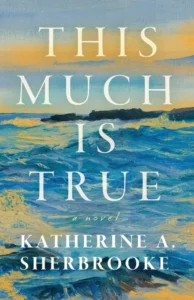
 If you grew up with the John Hughes films of the 80s, you’ve likely had to revisit that era’s codes of conduct and re-examine what you thought you knew. If you didn’t, Katherine Sherbrooke’s new novel, This Much is True, will take you there, asking key questions bound to spark challenging conversations.
On her 58th birthday, Veronica Harmon has a fulfilling veterinary career, a wonderful marriage, and three grown children, her youngest newly engaged and celebrating her first solo art show that very night. But when Veronica meets her daughter’s future in-laws, Ted and Belinda, she’s shocked. She immediately recognizes Ted from an incident during high school that changed the trajectory of her life. Having never told a soul about that night, Veronica’s past comes rushing back, threatening to destroy everything.
Tracey Palmer: In your acknowledgements, you mentioned that part of your inspiration for This Much is True was Molly Ringwald’s New Yorker essay, “What About The Breakfast Club?” I’m fascinated by this. Like you, and anyone who lived through the 80s, I also grew up with that film, along with John Hughes’ other iconic movies Pretty in Pink, Sixteen Candles, Ferris Beuller’s Day Off, and more. To some degree, they defined our generation. Could you share how Ringwald’s essay influenced this novel and your feelings about those films now?
Kathy Sherbrooke: Most teenagers probably think the world revolves around them, but in the 80s, John Hughes’ movies had those of us living in middle-class white suburbia convinced of it. His films were celebrated for capturing the essence of the teenaged experience, and I didn’t disagree. In fact, I’m embarrassed to say that I felt so “seen” by those films that I didn’t even notice the over-sexualization and mistreatment of young women in many of them. It was the reality I was living in, and I didn’t yet know how to question any of it.
Ringwald’s essay offers an honest exploration of her mixed feelings about a successful career so intertwined with films that she now recognizes as problematic, particularly Sixteen Candles. By the time I read her essay, I had been wrestling with the premise of this novel for years— namely that a woman is forced to reckon with the fall-out of a long-ago sexual assault when the perpetrator re-enters her life as the father of her daughter’s fiancé—and it broke open for me a new way to approach my story. I began to imagine what might have become of three of the characters from Sixteen Candles forty years after the night portrayed in that movie. The characters in the novel are mine (the names are changed) and you don’t have to know the movie at all for the book to make sense, but it was a helpful way for me to explore not only the dilemma at the heart of the book, but the cultural construct that set its events in motion. And if you do remember the movie and are now thinking, “wait, sexual assault in Sixteen Candles?” you’re not alone, which goes to the heart of what this book is all about.
TP: You tackle some tough subjects in this new book, but ultimately it’s about the burdens we as women are forced to carry and how hard it is to be free of them. What do you hope women, and men, will take away from this emotional story?
KS: Rather than one takeaway in particular, the thing I most hope this book will spark is good discussion. The beauty of fiction is that it can transform unwieldy or complex issues into something personal, something we can feel. That’s when I think we can have truly interesting conversations. I’d love to see this book inspire thoughtful discussion, or even serious debate about what accountability for past actions should look like and what we owe each other as humans. Why are we so reluctant to believe survivors? Who are we trying to protect? I also chose to tell this story from two points of view—mother and daughter—which I hope might spark inter-generational conversations about what has and hasn’t changed in the world for women, and what kind of shame or blame we sometimes unwittingly pass on, as men and women, to our daughters and to our sons.
TP: You have published four novels now, was the process of writing this latest one any different from the rest?
KS: Yes and no. I’m very much a pantser and tend to write into the fog to find clarity for any new story. This book sets up such an impossible dilemma, though, that I felt unable to get very far without knowing the answer to one driving question: What should she do? And I had no answer. So, I put the book down twice to write other novels. I’m generally not one to put aside an idea I feel strongly about, so that was a new and uncomfortable feeling for me. Eventually, though, I realized that the only way to figure it out was, once again, to write my way there. I had no choice but to put myself in my protagonists’ shoes, force myself to “live through” the weekend over which the novel takes place and trust that I would find my way to a resolution that would be true to my character and satisfying for the reader. Of course, the “weekend” I lived through proved to be another couple of harrowing years, but I’m really pleased with where I landed!
TP: Because we are all about Dead Darlings, were there any beloved characters, scenes, or plotlines you had to kill?
KS: I’m big on ruthless revision, so there are always more than a few darlings that don’t make it into any finished project, but here’s one that stands out for me. Once I knew the novel would be in conversation with a film, I had the idea of inserting what I called “interstitials” along the way. These were short scenes written like a screenplay, and I mean in every way: the font, the formatting, the stage directions, everything that goes into a proper screenplay. To further set these scenes apart, while the rest of the novel is told from the point of view of the mother and daughter, each interstitial was a conversation that involved the villain without either woman there. The scenes themselves worked well, and I still think it’s a cool idea, but I ultimately killed them. I worried it was a bit gimmicky and would give the ghost of a movie, if you will, too much emphasis. More importantly, I realized that the scenes gave the villain the mic, and given the subject matter of this story, he doesn’t deserve it.
TP: For This Much is True, you signed with a small press, Sibylline. For our readers, many of whom are aspiring authors, can you tell us about your choice to go that route and what the process was like?
KS: The publishing industry feels really in flux right now. After my agent and I parted ways, I began to wonder if it might not be time to explore doing things a different way. If you’re an aspiring author, you know how long querying can take, and landing an agent now feels more like arriving at an uncertain weigh station than hitching a ride to a publishing deal. Like many smaller presses, Sibylline accepts un-agented submissions, which means getting directly to the ultimate decision-maker. That felt like a great way to remove much of the friction from the process. I was also impressed by Sibylline’s entrepreneurial bent. Getting the attention of new readers is harder than ever, and I’m not clear how much traditional publishers are innovating in this realm. Sibylline is trying lots of new things, particularly in the world of digital marketing, and is applying those learnings to a growing crop of writers. I also appreciate Sibylline’s focus on publishing the stories of women over 50. Not only is it a huge demographic of writers and readers often overlooked, but that kind of focus helps build readership for the long haul. The editorial team at Sibylline immediately understood this book and its potential impact. It’s great to have a champion like that in my corner!
TP: My next question gives me pause because I know how much work goes into launching a new book. You hardly have time for anything else. (I’m in the process of gearing up for it myself, right now!) But for fans of your writing (of which I am one!), are you working on anything new? Can you give us any hints?
KS: Yes! I’ve found the best way to reduce the anxiety of a book launch is to get to work on something new. I can’t say too much yet, but like my second novel, Leaving Coy’s Hill, this one will be based on a real person, a woman who made an extraordinary impact in her time, but whose name has fallen too quickly out of public discourse. I’ve been doing lots of research, including reviewing original documents, talking with someone who knew her, and even staying in her former home, all of which has been quite inspiring. I’ve also been putting a lot of energy into a bi-monthly Substack newsletter, In Other Words, which explores what the evolution of words and phrases might say about our culture. Writing short posts on that platform has been a great way to stay connected to readers—including giving updates on upcoming book projects— and gives me the much-needed satisfaction of “finishing” something more than once every few years!
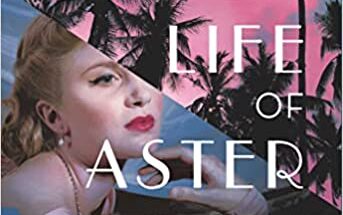
Katherine Sherbrooke is the award-winning author of a family memoir and four novels: Leaving Coy’s Hill, which was a finalist for the Massachusetts Book Award and selected by the New York Times as a notable book; Fill the Sky, finalist for the Foreword INDIES Book of the Year, finalist for the May Sarton Book Award, and winner of an Independent Press Award; The Hidden Life of Aster Kelly, PopSugar’s #1 pick for historical fiction in 2023; and This Much is True. Her work has also appeared in Cognoscenti and Zibby Magazine. Kathy served as Chair of the Board of GrubStreet, the nation’s premier creative writing center, from 2013-2023. She lives on the South Shore of Massachusetts.