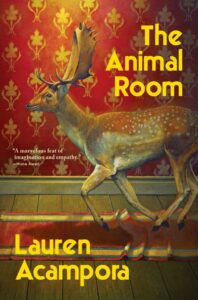
 I’ve been lucky enough to know Lauren Acampora since the late ’90s, when we were both editorial assistants at a big publishing house in New York. Lauren was, as she is now, inquisitive, joyful, thoughtful, intense, and watch-out funny. It’s no surprise that her latest book, The Animal Room, a collection of linked short stories, brings those qualities to bear. This is literary fiction at its best. Lauren subtly excavates American suburbia—in this case, the microcosm of Old Cranbury, CT—to reveal the urges that lie beneath. This is familiar territory for Lauren. Her first collection, The Wonder Garden (2015), was also a collection of linked shorts set in Old Cranbury and many of the characters will be known to readers of that lauded debut.
In The Animal Room, Lauren inhabits the sensibilities of the affluent and the browbeaten; flummoxed parents and well intentioned children, those who protect animals, those who experiment on them, and those who hunt them. Ambitions frequently become dangerous fixations. A psychiatric patient claims she is becoming a bird. An oil executive hosts a kindergarten fieldtrip at his suburban menagerie. It’s remarkable to see the myriad ways animals and humans intersect, and the result is an intricately woven web that questions the primal instincts humans possess. Those revelations accumulate and build over the course of the book to unsettling effect. In fact, the momentum Lauren harnesses by linking these short stories is one of its most exciting elements. (Sometimes you wonder: linked short stories or a novel in shorts?) The lives of these characters continue long after they’ve left the page, and it’s immensely rewarding to encounter them as ancillary characters in other stories, when the consequences of their actions are made clear.
I wanted to talk to Lauren about how she went about constructing this web, what brought her back to Old Cranbury and the eccentrics who live there, and of course, her fascination with the animal world.
Nicole Vecchiotti: Tell me about your relation to animals as a writer.
Lauren Acampora: Ever since I was young, I wanted to write stories about animals. Now, as an adult, I’m drawn to newspaper reports or stories about humans intersecting with the animal world. Sometimes successfully, sometimes accidentally, and especially when we overlap in ways that are unintended. Reports about a bear in a Florida retirement community or, you know, coyotes in Central Park fascinate me. I wanted to write stories about all the paradoxical relationships we have with animals. They’re so close to us and yet also foreign and scary, depending on the species and context. It’s a very fraught relationship that humans have with the natural world.
NV: Tell me what you discovered.
LA: Humans are weird. We’re really uncomfortable with our biological realities. We are animals, but we don’t always want to accept that. We tend to romanticize the cerebral, intellectual parts of ourselves. The thing that differentiates us from animals. We focus on our ability to rationalize and calculate and less on the instinctual parts of ourselves. Especially now, with AI. It’s almost like we’re projecting our intellects into this perfect, bloodless device. But the one part of our brains that hasn’t changed over the course of evolution still runs the show. It’s that primal part that tells us what to do for our own survival and propagation. And this became the undercurrent of the book.
NV: And what made you want to return to Old Cranbury?
LA: Actually, I’d been working on some other stories about animals, setting them all over the country. I had one in Texas. One in Wisconsin. All over. But the one character I knew I wanted to return to was Roy Fox, a character in my novel, The Hundred Waters. He’s a retired oil executive with a menagerie of exotic animals on his suburban estate. He was sort of a paper villain in The Hundred Waters, seen through the eyes of other characters as a maniac, collecting animals and destroying the environment. But I thought, Roy doesn’t see himself that way, right? So let’s write his story. What drives a man like that? And his story was set in Old Cranbury.
And then one day, I was in the shower—because all my ideas come in the shower—and I thought, wait a minute, why do these stories need to be set all over? Is there any reason why these stories can’t be set in the same town? Can’t they all be in Connecticut? And then the next thing you know, I knew the setting and the characters and all my ideas came alive.
NV: For the folks at home, this story, “Dominion” was selected for The Best American Short Stories 2025. So, you had ideas for stories and then you put the characters into those situations?
LA: Yes. For example, I knew I wanted to write a story set in a research lab with animal models—the laboratory mice and the people working with them. And I knew I wanted it to be a love story, and I wanted it to be told from the scientists working with these mice. That was the idea I had in my head that became the story “Husbandry.” And once I knew where the stories would be set, I was like, Oh, it’s Noah and Nayana! She’s back! I knew the characters and I could write the story. Isn’t that weird? At first they were just silhouettes. I didn’t know who the story would happen to. I only knew I wanted it to be a love story and I wanted it to be set in a lab.
NV: Do you often start with story ideas and then populate them?
LA: Yes. And I feel a little guilty admitting it. I feel like it’s supposed to be the other way. It’s supposed to start with character, right? I feel like I’m cheating. But I’ll cheat. I’ll do whatever it takes. All these characters are my little lab animals, and I put them in a maze and make them run around.
NV: What is the process like when you write a story that way?
LA: In the case of “Husbandry” I didn’t know what was going to happen. But I knew their backstories and what was driving them. So, I asked myself, okay, what’s happened in the last ten years since the Wonder Garden? What’s Noah been doing? Knowing who he is, knowing what was on his mind as a teenager, how he pictured himself and how he wanted to get away from home—it made sense that he’d go away and be at loose ends and then return to prove himself to Nayana, who’s been so successful.
NV: One of the most chilling stories for me was “Tank.” Chance is a tricky, violent six-year-old and his mother is afraid of him. She has an urge to domesticate him, but the violence in him is unnerving. The sense of dread in that story builds until the eruption comes. The prose is clean and straightforward, and it has an immense amount of power.
LA: That was hard to do, thank you. As a parent, there are times when you think, is this normal? Is this behavior normal development or is there something wrong? And for the most part, kids grow out of that and become functioning members of society. But what happens if those tendencies don’t go away? I thought, well, what if there’s a mom facing that. And I wanted to explore that feeling of being a parent to a kid who is very animalistic and may not change. For her, it precipitates another animal reaction that is considered unacceptable. That animal instinct comes through her like a bear, and it shocks her.
NV: Do you surprise yourself when you’re writing?
LA: The surprises to me are the confluences of the stories and how they echo each other in ways I didn’t intend. I think that there’s a subconscious river that flows through this process and puts things where they need to be.
NV: How do you edit something like The Animal Room? Once you’ve written the stories, I’d imagine there’s a lot to figure out. For example, where they fall in the collection and the character arcs the reader tracks, the chronology of the community as a whole.
LA: Oh, gosh. It was so difficult. I had written them to be disparate, freestanding stories, with the only connection being the theme of animal relationships. That’s it! And then they kept drawing closer together, and then they were linked, and then they were linking through other books—so, I had to just hammer them into submission.
NV: I’m really interested in the research fiction writers do—how you do your research?
LA: Oh, dear. I love doing research. It’s so much fun. Most of it is online. I get as much as I can. The last story in the book, “Pack,” is about Daryl and the police dog he’s training, Ajax. It required a lot of YouTube videos and learning terminology and what kind of equipment they use and what sort of dogs they train, and where do they get them and what’s their breeding line and—how does that all work? I wrote that story from the perspective of the retired police officer, which was way out of my experience. I was able to find a very kind retired police officer who’d worked with dogs, because I wanted to make sure the details were right, but also how the story read to him overall—it had to be relatable.
NV: Which story was the hardest to write in terms of craft?
LA: The Safari story, “Quarry,” was a craft challenge. I couldn’t quite land on the point of view, but I felt it was an important angle to include as there are so many layers to touch upon. Safaris in places like South Africa are fascinating, but people tend to gloss past the human issues to look at the animals who are living free.
To research the story I read TripAdvisor reports, one after another, about luxury safari lodges and which ones had the best food and what the accommodations were like, and the quality of the guides, et cetera. And I thought, well, what if I did it as a trip report—only made it more compelling?
When I teach a workshop, I almost always teach point of view because it’s a set of tools people forget they have. I’m so glad to have these tools at my disposal. Sometimes it’s what unlocks a story. For “Quarry” I used a journalistic third person, which limited the story to what can be seen and heard with no one perspective being privileged. It’s almost like there’s a fly on the wall reporting what’s happening at the dinner table. That distance is what solved that story.
NV: Craft-wise, this was a very arresting story. “Quarry” falls in the middle of the collection and serves as a bridge, like a little intermission.
LA: Yeah, it was different. I felt like it was wedged in there, but then I realized it served a purpose. It’s funny because originally the collection was just twelve stories, but my editor felt we needed something at the end. Some sort of epilogue. And I was like, you know, you’re right. What could that be?
And I thought of “Correction,” which returns us to the first story. And again, I was like, how am I going to write this? Who gets the point of view? Whose story is this going to be? Is it Leigh’s story? Is it Daryl’s? Are we going to take the dog’s point of view? How am I going to pull this off? And then I thought, oh, man, I’m going to try that journalistic, detached point of view and just tell it from a little bit of a distance.
NV: Yes, and it’s gorgeous.
Lauren Acampora is the author of The Wonder Garden, The Paper Wasp, andThe Hundred Waters, all published by Grove Atlantic. Her new collection of linked stories, The Animal Room, is forthcoming in June 2026 and features the story “Dominion,” which was selected for The Best American Short Stories 2025 and performed on stage for Selected Shorts.
Lauren’s short fiction and other writing has appeared or is forthcoming in publications such as The Paris Review, One Story, New England Review, Story Magazine, Guernica, Missouri Review, The Common, Prairie Schooner, Antioch Review, The New York Times, and LitHub, and was anthologized in The Best American Short Stories 2025. She graduated from Brown University, earned an MFA at Brooklyn College, and has received fellowships from MacDowell, Ucross, Ragdale Foundation, Art OMI, Cold Spring Harbor Laboratory, and the New York Foundation for the Arts. Raised in Connecticut, Lauren lives in Westchester County, New York with her husband, artist Thomas Doyle, and their daughter.