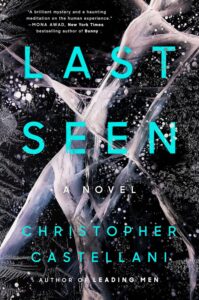
 Chris Castellani’s latest novel, Last Seen, offers a virtuosic account of the intersecting lives of four missing young men and their loved ones across decades. Part murder mystery, part ode to lost youth, part love story, Last Seen delivers a master class in structure and escalation that Celest Ng has called “a morally complex and life-affirming exploration of what it means to be alive, and the enduring power of love to transform, reanimate, and redeem.”
Chris is the author of five books, most recently the novel Leading Men, for which he received fellowships from the Guggenheim Foundation, MacDowell, and the Massachusetts Cultural Council. Leading Men is currently being adapted for film by Peter Spears (Oscar-winning producer of Nomadland) and Searchlight Pictures. He teaches at Brandeis, the Warren Wilson MFA Program, Breadloaf Writers’ Conference, and elsewhere.
If you’re in the Boston area, you can catch Chris at our Craft on Draft event at Trident on Tues 9/22. Find out more here.
Chris took time out from his busy summer teaching schedule to speak with Dead Darlings.
Marc Foster: Last Seen opens with a motif torn from the pages of a serial killer thriller —young Caleb, all alone, assaulted on a winter night en route home for Christmas Eve—but quickly hands off consciousness to James, Caleb’s former lover, now obsessed with the fates of dozens of other unfound boys, along with Caleb. What did you learn about training the reader during the opening pages this time?
Chris Castellani: Those openings pages are actually the newest section, written just a few days before the novel went out on submission. My agent and early readers all suggested that the book needed to start with James, both because he’s the closest avatar for the reader and because his storyline is the only one that ultimately intersects with all of the other storylines. In this way he’s also the “clock” for the book’s temporal structure and the “control line” for its experimentation with speculative elements. In other words, James (hopefully) helps the reader continually touch base with reality.
That said, he’s so desperate for a resolution to his lover’s story that he’s convinced himself that the Smiley Face Killers theory is real. Like many families I researched, he finds the theory strangely comforting, or, at least, more comforting than no theory at all.
My one regret about the opening section is that, by foregrounding Caleb’s disappearance and James’s obsession with Smiley Face, it might train the reader to expect more traditional thriller and True Crime elements to dominate the rest of the novel. Ultimately, though, Last Seen isn’t a whodunit; in fact, as the wonderful writer Michael Lowenthal told me, it’s more of an “anti-mystery,” which you’re maybe not fully prepared for after reading the opening section.
MF: Cross-talk among the dead boys—a kind of social media for the departed—offers another central motif in Last Seen, calling to mind Sing, Unburied, Sing by Jesmyn Ward and The Graveyard Book by Neil Gaiman. What led you to that convention, and how did it evolve in revision?
CC: I think it started when a poet friend casually said, “you know how rivers can communicate with each other, right?” and I pretended I did because I didn’t want to sound dumb or out of touch with nature. I was struggling with the early drafts of Last Seen, mainly because I was preoccupied with its external and logistical questions rather than the internal lives of its characters. When I did finally write the first line spoken in the afterlife – Matthew saying, “I am one of those boys they keep finding in the river,” I knew not only that I’d found the right voice, but that Matthew wasn’t talking only to me but to other boys like him. I spent a long time with Matthew, getting to know him, before he introduced me to his friends Caleb, Leo, and Steve and then I spent a long time with each of those guys individually to hear their sides of their own stories.
MF: Similarly, all four dead boys are immersed in bodies of water. Given the centrality of water in the Greek underworld (Hades), and in Hindu religion (The Ganges), how did your own approach take shape?
CC: I honestly tried hard not to think too much about the mythological or religious resonances. I worried that if I went too far in that direction, I’d end up creating too many one-to-one correlations. I tried to build a world that made sense within itself, one that stuck to its own terms and didn’t rely on other traditions for meaning. It’s maybe worth noting that I had a LOT more “world-building” in the first phase of drafts that explained how the boys could communicate, how/why they could follow only one living person, etc., how they could summon each other for communication, and all of my early readers suggested I pare it down significantly. Again, they were right, because the more you try to explain a fantastical world like this, the more it loses its appeal and exposes its (il)logic. Also, I wanted the focus to be not on the terms of the afterlife but on the hearts and souls of the boys who found themselves in it.
MF: For a novelist as well-versed in historical fiction as yourself—your most recent title, Leading Men, offered a razor-sharp evocation of mid-20th century Italy and the U.S.—how did you make use of near-history in Last Seen, with references to the early aughts through Covid?
CC: Well, you may have noticed that Matthew dies just a few weeks before the lockdowns of March 2020, and that all the other boys die years before that. I had no interest in revisiting life during the pandemic or exploring its effects on anyone’s psyche, but I knew I couldn’t avoid it entirely, which is why Covid shows up in various ways mainly to complicate the plot – for example, it delays the search for Matthew’s body.
It wasn’t Covid, but the AIDS epidemic that I made an effort to evoke. Midway through the drafting process, I was listening to Andrew Holleran’s Dancer from the Dance, a novel I’d read years before and which had haunted me for its documentation of the gay demimonde of New York and Fire Island in the late 1970s and early 1980s. It occurred to me that the Smiley Face Murder Theory brought up a lot of the same images and emotions and iconography from that period. The images of the men supposedly targeted by the Smiley Face Killers looked a lot like the mainstream images of the men lost to AIDS: young, white, handsome, innocent, cruelly cut down in the prime of their lives. I didn’t want to impose any sort of meaning on this parallel; instead, I wanted the reader to note the resonance and draw their own conclusions.
The most literal embodiment of this resonance is the character of Derrick, who bears a deliberate resemblance to Malone in Dancer from the Dance. At the end of Dancer, Malone dives into the sea at Fire Island and never reappears. In Last Seen, I reimagine him, rather fancifully, as the proprietor of The Gaze, a kind of limbo or bardo in itself – a refuge, at least – where men gather and connect outside the boundaries of their “real lives.”
MF: One aspect of this book that awes me is your ability to build suspense without the usual convention of a linear plot. How did you think about, and manage, escalation, in this novel?
CC: This was my agent’s #1 question when I told her the premise. “If I know all these boys are dead from the beginning,” she said, “why am I turning the pages?” I was aware that it would be very tough to build and sustain momentum for this reason, so I tried to be strategic about where, when, and how I’d reveal the exact cause of each boy’s death. For example, we learn relatively early what happened to Caleb, but we don’t learn how Matthew died until the 80% mark or so. I wanted the reader’s knowledge about each boy’s cause of death to affect the way they read further, and to retroactively affect what they’d already read.
Beyond that, I had four living characters to contend with, people whose lives had to go on despite the loss of their respective young man. Each of the living characters needed to have their own storyline and set of desires and obstacles, which was tough to squeeze into a 300-page novel. I wanted each of these people – Matthew’s mother Lori, Leo’s sibling Leo III; Steven’s lover Monica; and Caleb’s James – to find the peace and resolution they were looking for, and I hoped the reader would be invested enough in them to want that for them as well.
MF: Just when I think you’re centering Last Seen in queer characterizations like Caleb, you introduce us to a devastatingly well-drawn straight character like Matty. Do you consider Last Seen a queer novel, or are you uninterested in that kind of genre label?
CC: It’s strange because three of the four main characters are straight, and yet because Caleb and I are gay it’s considered by some to be a queer novel. For these same reasons, it’s also not considered by others to be queer enough. It’s been variously marketed as a thriller and a mystery and a True Crime novel, but the traditional thriller, mystery and/or True Crime reader will be sorely disappointed if they want it to follow the conventions of those genres.
If a book has elements of certain identities and genres – the trans, the speculative, the historical, the literary, all of which Last Seen has – does that mean it qualifies for each label? The problem most novelists face is that we try to write the most complex books we can, and then, to market them, our publishers have to boil them down to one or two very defined and highly limiting descriptors. And yet, nobody wants a novel to come with a list of ingredients, like a soup can. I love novels that shape-shift, that break conventions, that blur genres and that surprise. I tried to do that here, perhaps to my detriment, given how many readers want to know exactly what they’re getting.
MF: Another compelling set of themes in Last Seen is dependency and age asymmetry, as mediated through Caleb’s romantic relationship with James, and Steven’s with Monica. Can you talk about where those dependent pairings came from, and at what point in the revision process they took their final shape?
CC: I have to say it took even me by surprise how many so-called “age gap” relationships ended up in this book. In fact, there’s one in each of the four major storylines if you count Tessa and Kenneth as well as Leo III and Bonnie. I think this happened because – to me, at least – the power dynamics inherent in age-gap relationships are much more complex and interesting than, say, those in a relationship between two college students. I’ve always been deeply compelled by the question of power and currency in this context. For example, in Monica and Steven’s relationship, who would you say “holds the power?” Steven believes that if he exposed their affair to her husband, she would lose everything and he’d lose very little. Her wealth and status as his boss is a kind of currency, but so is his youth and physical strength. Shane, Monica’s son who is also beloved to Steven, complicates their power dynamics in ways that would be impossible to explore if they weren’t so far apart in age.
I was also really interested in the ways in which we all fetishize youth, and how that fetishization plays into the cultural obsession with the Smiley Face Killers. Late in the book, one character states fairly explicitly that we treat the untimely deaths of young men, especially young white men, very differently than we treat the deaths of young white women. When the boys turn up dead in rivers, we bemoan their loss of potential, the ways in which they might have changed the world for the better. When a young woman’s body turns up, the conversation invariably turns to a kind of victim blaming. Some of these dynamics are at play in the age-gap relationships as well.
MF: Thinking across diverse media types—written fiction, film, TV—can you share what bodies of work you used for comps during the drafting and revision process of Last Seen?
CC: Fiction-wise, I’d say this book has elements of or was inspired by The Virgin Suicides, Lincoln in the Bardo, Demon Copperhead, The Lovely Bones, Dancer from the Dance, and a wonderful short story I teach to every college and grad student called “Merry-Go-Sorry” by Cary Halladay. “Under Ice” by Kate Bush was played frequently as I wrote certain scenes. The epigraph to the novel, the poem “Short Talk on Walking Backwards” by Anne Carson helped me immensely to unlock many of the characters and establish the mood/vibe.
MF: You’ve taught fiction writing in diverse settings, from your role as founding Artistic Director at Grub Street to more traditional institutions like Brandeis and Brown. What role does teaching play in your practice nowadays?
CC: Teaching has always been central to my life as a writer. It was my high school English teacher, Chuck Selvaggio, who first inspired and encouraged me to write fiction, and every time I take any kind of instructor or mentor role, I use Chuck – as well as extraordinary friends and teachers like Charles Baxter and Margot Livesey – as my guides. I try to emulate their generosity and curiosity and passion, and I strive for their level of insight into how to help my students write better version of the texts they bring to workshops.
I have many opportunities for this because, at present, I’m teaching writers at pretty much every stage of development: exceptional teenagers at YoungArts; college students at Brandeis; graduate students at Warren Wilson; and adult learners at various conferences around the country. It’s such a cliché, but I always learn something essential from these writers, whether it’s an approach to scene-making or a new author to read or how to be just a bit less jaded about this maddening art form to which we’re all hopelessly addicted.
MF: What’s next?
CC: I plan to go back to a coming-of-age novel I set aside to write Last Seen. It’s supposed to be funny and sexy and heartwarming and maybe a little shocking, but I’m very doubtful I can pull all of that off. I guess we’ll see?
Chris Castellani is the author of five books, most recently the novel Leading Men, for which he received fellowships from the Guggenheim Foundation, MacDowell, and the Massachusetts Cultural Council. Leading Men is currently being adapted for film by Peter Spears (Oscar-winning producer of Nomadland) and Searchlight Pictures. He teaches at Brandeis, the Warren Wilson MFA Program, Breadloaf Writers’ Conference, and elsewhere.