
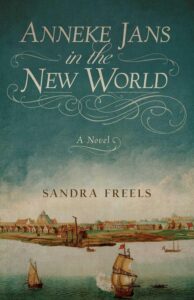
 Published just as New York celebrates its 400th birthday, Anneke Jans in the New World by Sandra Freels takes us on a sweeping journey among the first Dutch colonists through the eyes of a spirited young mother, who faces the unknowns of 17th -century New Amsterdam after fleeing the Old World in search of a better life.
It’s 1630, and Anneke Jans has just arrived in the fledgling colony of New Netherland with her husband, Roelof, and their two young daughters to create a new life for herself and her family. One of very few women in the colony, Anneke quickly realizes that she will need to make her own rules if she is to survive.
When Roelof dies, Anneke marries Everardus Bogardus, the flamboyant minister of the Dutch Reformed Church. With this marriage, Anneke joins the elites of the colony—but when the colony’s new director provokes war with the region’s American Indians, and her new husband emerges as the head of the anti-war opposition, she also finds herself in the midst of political turmoil. As difficulties mount, she must rely more than ever on her quick wits to protect herself and her growing family.
Based on real events and meticulous historical research, Anneke Jans in the New World tells the story of an ordinary woman who lived an extraordinary life.
D.H. Haddad: When did you first learn about Anneke, and how did that interest ignite a spark to write this novel about her life and times?
Sandra: I first encountered Anneke Jans in 2020 while doing genealogical research. I believe she is my 11G grandmother. Genealogy, to me, is not so much about names and dates as it is about studying history at the level of the individual. The lives of Anneke and her neighbors are fairly well documented in the Council Records of New Amsterdam, made available online by the New Netherland Institute. During the pandemic I spent hours sifting through those records looking for references to Anneke and to other individuals from whom I thought I was descended. In time I felt I had a good sense of what Anneke’s community was like. I selected Anneke as my protagonist because her life had so many astonishing twists and turns.
I want to highlight your thoughtful Author’s Note, which explains the choices you made for this historical fiction novel, acknowledging the harms done to enslaved Africans and indigenous Americans in this violent period of early colonial America. How did your desire to confront ugly realities of the past impact your approach to writing about Anneke Jans and her world?
Before I met Anneke, I knew very little about the 17th century. As I studied her life, I was struck by how many of the major preoccupations of our modern world have their seeds in her world. I tried to imagine what it would have been like for a person living at that time to witness or even to contribute to the very beginnings of the displacement of American Indians, the enslavement of Africans, and the overconsumption of natural resources without fully understanding the significance of what was taking place.
How unique was Anneke among colonial women vs. if we had the diaries of a thousand other women from her time? What is a fun and interesting historical fact or tidbit about Anneke and her world that you’d love to share with readers?
Anneke’s decision to step onto a rickety sailing vessel and travel to an unknown land in search of a better life would have made her an outlier among a thousand European women of her social class, but it would have been commonplace among a thousand colonial women. Anneke is unusual among colonial women in part because of her second marriage and in part because of her material success. With her marriage to Dominee Everardus Bogardus, she became one of the elites of the colony, and she died a property owner.
The baptismal records of the Dutch Reformed Church typically record the names of parents, infants, and baptismal witnesses. The number and prestige of baptismal witnesses tell us a lot about friendships, family alliances, and social standing. Between 1639 and 1647, Anneke witnessed at least ten baptisms, the most prestigious being that of Petrus Stuyvesant’s son, Balthazar Lazarus.
I laughed when Anneke noticed that New Amsterdam is full of young men, and while they’re diverse, they’re all men, which causes Anneke to clutch her daughter Sara. “We’re on our own here, girls,” she whispered. “We’re going to have to make our own rules and be very quick-witted and careful if we mean to survive.” Would you say this line of dialogue captures the essence of Anneke’s spirit, character, and voice? How did you approach and discover Anneke’s voice, as the main character through whose POV we see and feel so much?
I agree that the line you’ve quoted captures Anneke’s essential characteristics. I am fascinated by her because she is the quintessential border crosser. She is a double immigrant—first from Norway to Amsterdam and then from Amsterdam to the New World. She is a Lutheran in a Calvinist culture, a woman in a predominantly male society, a person of low standing in a rigidly hierarchical world. She is watchful and wary, never certain she is doing the right thing, constantly alert to the need to adjust her behavior in new and unexpected circumstances, and never fully aware the consequences of her actions.
When Anneke and Roelof’s first talk with Dirck and Christine, as they ask their hosts questions about the lay of the land, the “Wilden” indigenous peoples are described as diverse, socializing in various tribes, speaking different languages, sometimes going to war with each other, etc. Can you elaborate on some of the primary and secondary sources, like Dutch history books and journals about New Amsterdam, to get a sense of how they viewed indigenous American tribes (and slavery)?
The Council Records are the best primary source for understanding Dutch attitudes toward local American Indians. Although there are numerous misapprehensions in the records, they do distinguish among various tribes and refer to tribal leaders by name. Recent archaeological studies give us a better understanding of the material culture both of the Dutch and of the local peoples and of their interactions.
The Mohican siblings Welanie and Kitpul are the only fully fictional characters in the novel. Their interactions with Anneke’s family illustrate the cross-cultural influences of the time, and even as relations between the colonists and the Indians decline, Anneke’s friendship with Welanie remains in her memory as a golden ideal of what might have been. I used the online Lenape Talking Dictionary for some of the language and gestures of the siblings.
The Council Records are also the best primary source for understanding Dutch attitudes toward slavery. Enslaved Africans were brought to the colony as early as 1627, but at this early period “servitude” was still a fairly fluid notion. Recent studies by such scholars as Andrea C. Mosterman, Nicole Saffold Maskiell, and Jeroen Dewulf help us better understand how slavery evolved during the Dutch period.
When Roelof dies, I was struck by how immediately Anneke was instructed not to grieve, as well as the writing style portraying her grieving process: “Anneke herself worked mechanically with the same thoughts running through her mind like a shuttle across a loom: mix the dough, sin to grieve, pat the dough, sin to grieve, mark the dough, sin to grieve, bake the dough, sin to grieve.” I love the use of literary devices like anastrophe and asyndeton here. What aspects of their culture and religious practices did you want to show, when you wrote this lugubrious scene? And how do the dialogue, emotional interiority, and narrative description of the mourning process depict different, overlapping aspects of their funeral practices and culture?
The Dutch Reformed Church did not prohibit grieving, but because of their belief in predestination, excessive or prolonged grieving was perceived as questioning the will of God. Anneke’s mother, Tryn Jonas, exaggerates when she tells Anneke it’s a “sin to grieve” because she wants her to get on with the urgent business of finding another mate. Marriage records of the period show that everyone—men and women alike—remarried as quickly as they could after the loss of a spouse. Life was just too difficult in the early modern world to manage on one’s own.
Anneke’s second husband, Evert, has his own fascinating backstory, characterization, and allyship with African families in the colony. Is this based on historical research, and what scenes or aspects of his character were fictionalized for the narrative?
Evert Bogart, aka Everardus Bogardus, was and still is a controversial figure. The best source of information about him is Willem Frijhoff’s biography Fulfilling God’s Mission: The Two Worlds of Dominie Everardus Bogardus, 1607–1647 (2007). It is true that Bogardus was raised in an orphanage, that he had visions as a youth, and that he served in Africa before coming to the New World. It is likely that he had a hand in writing the anonymous Remonstrance of the Eight Men, but there is no evidence that he was involved in the petition that resulted in half-freedom for 11 enslaved Africans or in the mock execution of another. Between 1639, when Bogardus began keeping baptismal records, until his death in 1647, he baptized 39 children of African descent, but other dominees in later years discontinued the practice, thinking it a ploy on the part of parents to gain freedom for their offspring.
Evert was then and is now a polarizing figure. Some people see him as a saint and others as a buffoon. I wanted to depict him as a man with deeply held spiritual convictions and an equally strong desire for worldly goods, which he regards as a sign of God’s favor. His behavior is erratic and at times dangerous, but his instincts are good. I also wanted to show that in addition to his very visible public activities he was also a family man who at the time of his death left behind four small sons, whom he surely loved.
ABOUT THE AUTHOR:
Sandra Freels majored in Russian at Indiana University and completed a PhD in Slavic Languages and Literatures at Stanford University. The author of three textbooks, she headed the Russian program at Portland State University for many years. An interest in genealogy led her to the Council Records of New Netherland and the delicious stories of the people who once lived there. She claims descent from Anneke Jans and sixteen other major and minor characters in Anneke Jans in the New World. At present, Sandra lives with her husband Joel and their two cats in Portland, Oregon.

1 comment