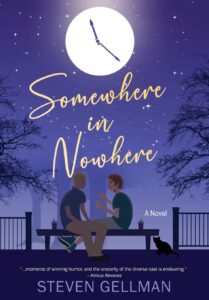
 Steven Gellman’s debut YA novel, Somewhere in the Nowhere (April 14, 2026 by NineStar Press) tells the story of Simon Bugg, who is navigating a lot as senior year begins: a new school, coming out, and maybe even an alien in his stomach that’s trying to kill him.
Timothy Deer: I want to start with genre. This is your first novel, so what drew you specifically to YA?
Steven Gellman: I came to writing in a pretty unexpected way. I’d always loved books, but I never once thought about writing one myself. Then I was at a book festival and wandered past a booth for a writers’ center. They asked if I was a writer, and I said no—I’m a singer-songwriter. And they basically said, “It’s in your title.” That stuck with me.
Then COVID hit, and as a working musician, all my gigs disappeared. I suddenly had time, and I remembered that conversation. So I thought, okay, I’ll write a book. The question became: what kind? I read across genres—sci-fi, fantasy, mystery—but I kept coming back to what gave me comfort growing up. That was Judy Blume. So I decided I wanted to write a classic coming-of-age story, but with LGBTQ+ characters.
TD: Since you mentioned your background, how did the transition from songwriting to fiction feel?
SG: At first, I thought they were completely unrelated. When people asked, I’d say no connection at all. But my thinking has shifted a lot. Now I see that songwriting absolutely prepared me for this. A four-minute song is still storytelling—it’s just compressed. You’ve got limited time, but you also have music to help carry emotion. With a novel, you have more space, but it’s harder in some ways because you don’t have that musical layer helping you. You have to create feeling purely through words. So they’re different, but I can see now that I’ve been working toward writing a novel my whole life without realizing it.
TD: Given you’re a songwriter, I was expecting song lyrics to appear in the book. Did you ever consider including them?
SG: I actually did—in the first draft, there were tons of lyrics. But they weren’t mine; they were snippets of existing songs referenced in the book. Then I learned the hard way that you can’t just do that without paying for it—which, as a musician, I should’ve known. So those all got cut early on. That said, the third novel I’m working on now is specifically about music, so there may be lyrics in that one.
TD: You’ve mentioned that you’re working on multiple books—can you talk a bit about that?
SG: I just turned in my second novel to my agent, and I’m working on a third. They’re all standalone stories, but they exist in the same world. Characters cross over in small ways, so if you read all three, you get a bigger picture, but each book works on its own. The third one leans heavily into music. I knew music would show up eventually—it’s such a huge part of my life—but I didn’t want it to feel too on-the-nose in the first book.
TD: I was curious about the title. It’s such a strong phrase—was that always the title?
SG: Yes, and it actually comes directly from one of my songs. That song was basically the first version of the novel. I took that four-minute story and expanded it into a full narrative. All three books I’m writing are based on songs I’ve written. And for this one, I even have a limited-edition EP coming out with songs inspired by the novel.
TD: That’s a great crossover. Do songwriting and novel-writing feel like they come from different parts of your brain?
SG: At first, yes—completely different. And even now, I approach them differently. Songwriting is something I’ve been doing for years, and it has its own rhythm and instincts. Plotting a novel is a totally different challenge. Even though I now see the connection between the two, they still feel like distinct creative modes.
TD: Your character names are really distinctive. What’s your naming process?
SG: Honestly, it’s not very glamorous. I just go with what feels right in the moment. I’ll try a few names, reject most of them, and then one clicks. It’s very instinctive. Sometimes too much so—I had a cousin read my second book and she asked why I named a character after her husband. I hadn’t even realized it. It just sounded right at the time.
TD: That’s great. What about Simon specifically? Did you ever hesitate, given how iconic that name is in queer YA?
SG: I did think about it. The funny thing is, the last name came first: Bugg. That goes back to an earlier version of the story I was considering, which was more middle grade, almost in an Artemis Fowl vein. I liked how “Simon Bugg” sounded, so I kept it. Later, when the book became what it is now, I had a moment where I realized the association. I tried other names, but none felt right. So I stuck with Simon and figured I’d change it later if needed. No one ever asked me to.
TD: On a craft level, why did you choose the first-person present tense POV?
SG: It was about getting inside Simon’s anxiety. I wanted the reader to feel it—to make the book itself feel anxious at times. First person felt like the only way to do that effectively. It also makes the story more intimate. And I’ve stuck with that approach across these books.
TD: Did you have any dream casting in mind while writing? Especially for Carole.
SG: I’m so glad you asked about Carole—she’s my favorite character. My dream casting for her is Brie Larson. I can just see it so clearly. My husband suggested Rachel McAdams, which I also loved. But I wanted just a bit more edge, and Brie Larson hits that perfectly.
TD: That’s a great pick. You can’t do better than an Oscar winner! Let’s talk about representation. The book includes a wide range of identities, and it feels very natural—not forced. How did you approach that?
SG: Early on, I wrote “diversity is a priority” in my notes. I didn’t fully know what that meant yet, but I knew it mattered. Then I thought about my own life. I grew up in a diverse community—my friends didn’t all look like me or share my background. So I drew from that. When the characters came to me, they came fully formed. I knew who they were—their backgrounds, their identities. It wasn’t something I had to layer on later.
There’s a scene in the book where Simon and Mags talk about their mothers and guilt—that came directly from a real conversation I had with a friend. So some of it is drawn very directly from lived experience.
TD: The book also has a lot of pop culture references—music, fantasy, TV. I especially loved the Brakebills reference from the Magicians. How did you choose them?
SG: That’s just me. I’m a nerd before anything else—before being a musician or an author. I love all of it: Lord of the Rings, Marvel, everything. So those references just seeped in naturally. And I’m leaning into that even more in my second book—it’s actually called Nerd’s Holiday.
TD: Finally, I wanted to ask about the cats, both as characters and as a graphic element in the book.
SG: For me, they represent comfort. Simon’s world is kind of spinning out of control, but the cats are a constant—a place of safety and calm. That theme carries through my books. There’s always an animal, and they all represent home and coziness in some way. In this book, it’s cats; in the next, it’s a hamster. The visual element with the cats—the little breaks in the text—that was actually my publisher’s idea. I loved it immediately. When you flip through the book, it looks like the cat is moving across the pages.
TD: It works really well – and it made me think of Jonesy from Alien!
Steven Gellman is an award-winning songwriter turned author. Steven has found his passion for writing coming-of-age fiction that centers LGBTQ+ voices and the real-life challenges of navigating adolescence in an ever-changing world. Somewhere in the Nowhere is his debut novel. Steven lives in Maryland’s Piedmont region with his husband and a houseful of rescued companion animals.