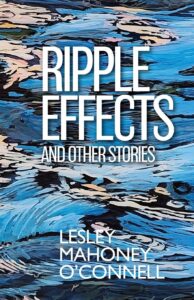
 I absolutely loved Ripple Effects and Other Stories, Lesley Mahoney O’Connell’s debut collection of short stories. Set in coastal communities on New England’s South Shore, these sharply observed and lyrical stories that shine a light on people who feel like outsiders as they try to make sense of lives that may seem ordinary but are far from it. The sea itself is a forceful presence in this collection, shaping the world of its characters as they struggle with loss and trauma and somehow manage to find hope.
These dazzling and quietly moving stories have earned high praise:
“Ripple Effects marks the arrival of a writer with remarkable emotional intelligence and a gift for illuminating resilience at the heart of ordinary lives.”
— Kathy Fish, author of Wild Life: Collected Works
“Captivating, clear-eyed stories of women and men at crossroads moments….You’ll be glad to know these people and enriched by the time you spend with them.”
— Ron MacLean, author of We Might as Well Light Something on Fire
I was delighted to speak with Lesley about her layered and beautifully crafted stories, putting together this anthology, her writing process, and so much more.
Emily: Many of these thought-provoking and lyrical stories are set along the South Coast of Massachusetts and images of water flow beautifully through them. In your preface you mention that it wasn’t until you “came to see these stories as part of a collection that a nuanced water motif announced itself, sometimes as subtly as rain, other times as boldly as the ocean anchored during a windstorm.” Can you talk about the process of putting this collection together and deciding how to organize it?
Lesley: I wrote these stories over many years. It wasn’t until I began to conceive of the stories comprising a collection that the water thread became more obvious and it served as a unifier. My stories aren’t linked in the sense of shared characters, but in addition to the water motif, I think they connect thematically; the characters are outsiders in their own worlds trying to make sense of how life has landed for them and, in many cases, finding hope while coming to terms with reality.
On a more technical level, I took an online class (“Building Your Collection: A Master Class for Short Story Writers”) through One Story magazine with the author Patrick Ryan. It was almost like a gift in that it was offered just a couple months after I’d completed a full draft of the collection. We looked at different strategies for organizing stories, including story length, tone, and points of view. For example, the collection features three short flash fiction pieces that I peppered throughout. I like to think of those as intermezzos, in between longer stories. I also aimed to vary points of view in the sequence and begin with what feels like one of the strongest stories. Another guiding principle was to make sure that, along with each story, the collection itself has an arc. It was important to me that the collection conclude on a tone of hope, and I hope readers will feel that.
How did your experience with Grub Street’s Short Story Incubator help shape these stories?
Our instructor, Ron MacLean, is not only an excellent and encouraging teacher and mentor, but also a master at revision. At the outset of the multi-month program, he gave us “The Big Book of Everything,” which is a priceless guide to unpacking the process of creating a story and then a toolkit for revising. When the class began, I thought most of the stories in the collection were “done” or “close to done.” Participating in the Incubator gave me new perspective on the stories and insight into ways to improve them, thanks to Ron’s guidance and my fellow incubees’ workshopping. I revised during and following the class, taking the existing stories to the finish line. After the Incubator concluded, I added more stories using the lens of “The Big Book of Everything.” Similarly, I find that when I write now, I am automatically applying the principles I learned—resulting in much stronger first drafts!
Your story, “Ripple Effects,” begins breathlessly with a young boy swimming after school lets out for the summer, who states, “As we stripped down to our underwear in the darkness and dove off the pier, it seemed like anything was possible.” But all that changes after a tragic event. The story ripples effortlessly forward through time as it follows his struggle to make connections in spite of the grief and loss in his life. What was the inspiration for this moving story, and what made you decide to use its title for your collection?
This story was originally inspired by a workshop I took with Kathy Fish, whom I think of as the queen of flash fiction. Interestingly, many of the stories in my collection were spawned by a Kathy Fish workshop. Her classes are all generative and that is so freeing; they allow the space to write without the distraction of your inner critic.
For this particular story, it was an exercise on diction and word choice that involved creating a word bank to draw from and build on to deepen the story, to replace any generalities with specifics, and hopefully reveal an emotional layer that resonates. In the case of “Ripple Effects,” some of those words were “fishmonger,” “gulls,” “ruddy.” Those words built the scene where the main character runs down to the docks to tell his father, a fishmonger, devastating news. I built on it from there. Ultimately, this section serves as a sort of extended backstory or standalone prologue for the rest of the story. This was also a story I deeply workshopped in the Incubator, focusing on building meaning through motion and connective tissue: Latin and swimming, for example.
It wasn’t until I had engaged with my publisher, Golden Antelope Press, that I decided to rename the story (originally “Surfacing”) to “Ripple Effects.” I think it makes sense as a title in the context of the story itself—how life’s actions and inactions create ripples that influence the way forward and offer context for the past—and the collection as a whole.
Quincy’s quarries are legendary. Those of us who live near them have all heard the stories about the boys jumping off the cliffs into them, the ones who died or got hurt, and the scary things hidden beneath the surface. Before they were mostly filled in, diving into the quarries was a sort of rite of passage for Quincy boys. But I especially love that your story “Quarries” is not about a boy. It’s about Jane, a girl who falls for a boy who jumps in quarries but wants to do it herself. Jane is supposed to get good grades and care about her sister who is seriously ill, but what she really wants is to be reckless and define herself in a way that defies her family’s expectations. What led you to tell this story from her point of view?
I have always been fascinated by Quincy’s quarries. There’s a mystique, allure, and a danger to them. I knew people who regularly jumped them and was familiar with stories of those who died jumping almost as folklore. By the time the quarries found their way into my writing, the city had drained them and filled them. But because I never physically visited the quarries or jumped myself, I think that’s what led me to write about them almost as a character themselves, from the point of view of someone a bit on the fringes of the quarry culture—though Jane does jump! I also set the story in the late-’80s/early-’90s, the time I was in high school and when I first became aware of quarry jumping.
The title “Seawall” feels like the perfect metaphor for this story about Catherine, a young woman who is responsible for her at turns exasperating and endearing neurodivergent brother, and who at the same time longs for a life of her own. Just as the seawall on this stormy day must hold back the churning and uncontrollable ocean, she’s tasked with reining in her determined and rigid brother, Theo, and it’s not a responsibility she asked for. Her mother left her with him.
I feel like women often face situations like this, but I don’t often see them in stories. I was especially moved by how sharply, but at the same time tenderly, you depict her brother. What drew you to this story and how did you develop the character of Theo?
Interestingly enough, it was setting that drew me to this story, not character. My first job out of college was as a reporter for the town of Duxbury, Mass. I did a lot of reporting about debates over Duxbury Beach’s piping plover population, beach grass planting, conservation efforts, and off-road vehicle regulations. The story is not set in Duxbury, but rather on Cape Cod, where towns are similarly at odds over the same issues. I wrote the story years after my reporting on the subject, but it had stuck with me enough—as topics often do for writers, I think—to explore it in a story.
I developed the sister character of Catherine first, and Theo came next as a source of conflict. Somehow the setting of a beach rife with its own conflicts, an unrelenting storm, and the wild ocean, inspired me to explore their complicated relationship—how Catherine is at odds with her circumstances and responsibilities but ultimately finds a new way to make sense of her world, her brother, and the intersection of the two. And now, many years after writing “Sea Wall,” I live one town over from Duxbury, where piping plover protection and human recreational access to the beach continue to be hot topics.
There are so many captivating characters in this collection: vulnerable men, tough women who walk away from children or partners, women who quietly challenge the roles laid out for them, and people who work in seemingly ordinary jobs that are not ordinary at all, like the trucker in “The Line Between the Beautiful and the Lonely,” who is also an artist.
I’d gladly read more about the people in these stories. What’s next for you? Have you thought of writing a novel or more stories about them?
“Sea Wall,” the collection’s opening story has stayed with me and has inspired new possibilities—maybe due to the fact that I’m living a few miles away from the setting from which the original story idea sprung. I’m not done with these characters or this setting; the story has become the anchor for a novel-in-progress. I am also working on some essays that I see as adjacent to my collection.
What are some of your favorite short stories or novels?
There are so many, it’s hard to choose! But some of my all-time favorites include the short story collections Birds of America by Lorrie Moore, Florida by Lauren Groff, A Visit from the Goon Squad by Jennifer Egan, and Five Tuesdays in Winter by Lily King; the novels Bel Canto by Ann Patchett, The Hours by Michael Cunningham, We the Animals by Justin Torres, Hello Beautiful by Ann Napolitano, Sing Unburied Sing by Jesmyn Ward, Beloved by Toni Morrison, and Virginia Evans’ The Correspondent. For short stories, a few: “Bullet in the Brain” by Tobias Wolff, “The Swimmer” by John Cheever, and “The Christmas Miracle” by Rebecca Curtis.
Can you tell me about your writing process? Are you a pantser or a plotter, or something else?
I’ll go with “something else”—I’d call my process more of a hybrid of pantser and plotter, skewing more toward pantser. I often start with an image, a lyric, a line of dialogue, setting, or a small character sketch, and then build toward a plot and hopefully, emotional resonance. I am drawn to language and the sound of words and sentences strung together, so I often start with that and then work in reverse to build a story’s scaffolding.
In keeping with our blog name, was there a darling that you had to kill when you were working on these stories?
Yes! The collection originally included a fourth flash fiction piece. My publisher raised the possibility that it didn’t quite fit with the collection and I ultimately agreed that it was a bit of an outlier. I still love the story and hope to find another home for it!
Lesley Mahoney O’Connell’s fiction has appeared in Post Road, Psychopomp, and Solstice, and earned honorable mentions from Glimmer Train and Carve. She has studied at Boston’s Grub Street and Fine Arts Work Center in Provincetown, Mass. She works in communications, marketing, and digital strategy, and lives on the South Shore of Massachusetts with her husband and son.