 When Daphne Kalotay first heard actor-author Julia Whelan narrating an audiobook back in 2018, she instantly became a fan. As she listened to Julia’s other notable performances (Gone Girl, My Year of Rest and Relaxation, and more), Daphne dreamed of Julia narrating one of her own books. That dream recently came true.
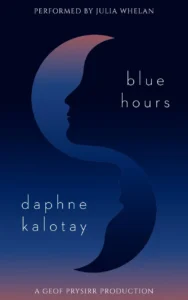
Daphne’s third novel, Blue Hours, is now an audiobook performed by Julia. Listen to a sample—HERE. A “spellbinding” (Booklist) mystery linking Manhattan circa 1991 to eastern Afghanistan in 2012, it tells the story of a life-changing friendship between two memorable heroines. I recently had the privilege of chatting with Daphne about audiobooks, narrators, and telling stories that highlight the impacts of foreign wars.
Tracey Palmer: Congrats on the audiobook for Blue Hours! When the novel came out in 2019, it was very well received. Reviews were overwhelmingly positive, and in fact, it was a 2020 Massachusetts Book Award Must Read. I guess my first question is, what took so long to release the audio version?
Daphne Kalotay: Back when I sold the book, I retained the audio rights, because even though the publisher (TriQuarterly) is a great press with a long history, they didn’t appear to be releasing their books in audio—and audiobooks are crucial to an author’s outreach. So I wanted to prevent ending up in a situation where there was no movement on the audio front. But I didn’t have an agent at the time and couldn’t really do much on my own, which meant a long lag before I was able to succeed in finding a really good audio option.
TP: I hear you landed the “Adele of Audiobooks” Julia Whelan as your narrator. How did you manage to get her? Why was she right for your novel? And how did you feel when she said yes?
DK: I’m a big consumer of audiobooks and first listened to Julia Whelan back in 2018 (narrating Olga Tokarczuk’s Flights). Her cool yet nuanced delivery was perfect for that book and is also something of her signature. I immediately started listening to her other performances and thought she’d be ideal for Blue Hours, which has a sort of almost lightly sardonic first-person voice. I also started reading Julia’s own books and felt we had a similar sensibility.
Then in 2024, I saw that she was starting her own production company and that while its focus seemed to be romance, the company appeared to be acquiring other books, too—including a story collection. I’d recently released my own collection, The Archivists, also retaining those audio rights, and thought Julia’s lightly wry delivery would be perfect. First I listened to the story collection her company had produced; I’d already read the physical book and was really impressed with how the audio production—which used multiple narrators and was just superb overall—expanded my understanding. So I wrote to Julia at the company address, introducing myself and explaining my situation. She read both The Archivists and Blue Hours, and from there things proceeded, including the decision to release Blue Hours first, since as a novel it will have broader appeal.
I think my timing was lucky, in that the company was just starting out and under the radar, still curating a list of projects. As for how I felt: elated and a combination of stunned and Well, naturally! since I’d already imagined Julia as the ideal narrator and had put the thought out into the universe years ago.
TP: Audiobooks are also available for your two other novels: Russian Winter and Sight Reading. What advice do you have for our readers about choosing the right narrator for an audiobook?
DK: Authors don’t always have a choice of who will perform their audiobooks. For Russian Winter, the publisher chose the narrator, Kathleen Gati, and I lucked out. She’s an accomplished actor with a similar cultural background to mine; I remember listening to the audiobook and hearing her pronounce my last name, and it was the way a Hungarian would say it. For Sight Reading, I was able to choose the narrator—Laurel Lefkow, another expert—and once again was really pleased.
As for advice, for those who do have a say in the matter, it’s of course partly a matter of personal taste, but I think the most important question is whose delivery will best portray your message. Listen at length to the possible narrators. Whose performances do you most enjoy? What always strikes me about Julia Whelan’s performances is the way her intellect is an aspect of her narrative skill; I mean that you sense in her performance her consideration of the sentences she’s reading. If you’ve listened to a lot of audiobooks, you know that this sort of attentive precision is not always the case!
TP: Your award-winning short story collection, The Archivists, came out in 2023. I’m sure our readers would love to know what you’re working on now. Can you give us a hint?
DK: I’ve just finished a partly historical novel inspired by my parents’ childhoods and by a recent real-life discovery in a Baltic forest.
TP: I think I mentioned to you that when I started writing my novel, also partly set in Afghanistan, I closely read Blue Hours. I’m happy to report that my debut novel, Alive Day, is being published in April 2027. So, thank you for the inspiration!
DK: That’s a huge accomplishment, Tracey, and I’m honored to have been part of your inspiration. These stories, about the impacts of our country’s foreign incursions, are extremely important; Kamila Shamsie famously said, back in 2012, “Your soldiers will come to our lands, but your novelists won’t.” Of course, this is partly an aspect of the American publishing industry. When I was shopping Blue Hours, some editors shied away from the part that was set in Afghanistan—when in fact it’s our profound responsibility to write about these subjects.
The Blue Hours audiobook is available now or pre-order at 20% off!
Daphne Kalotay is published in 20+ languages. She is the author of five books concerning the arts, war, and cultural heritage. Her work includes the award-winning novels Russian Winter, Sight Reading, and Blue Hours, and two story collections: Calamity and Other Stories and, most recently, The Archivists, winner of the Grace Paley Prize and longlisted for the Joyce Carol Oates Prize, among others. Daphne lives in Somerville, Massachusetts, where she is a special program instructor in the Masters in Creative Writing & Literature Program at Harvard University’s Department of Continuing Education.