
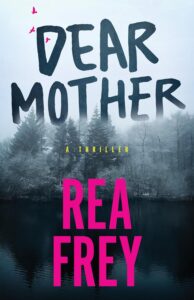
 A complicated relationship with your mother is one thing, but Isabelle Archer’s suspicion that her mother killed her siblings in a horrific fire years before is more than complicated. Author Rea Frey’s new page-turning thriller, Dear Mother (Thomas & Mercer, April 28, 2026), explores how that event kept Isabelle away from her picture perfect hometown deep in the forest of the Pacific Northwest for 25 years, busy with her life as an investigative journalist. When her mother is found dead and Isabelle is called back to settle her mother’s affairs, the past comes rushing back and threatens both her hard won life away from the childhood trauma and her precious family. But her journalistic instincts kick in and she’s forced to look at the past in a whole new light—and shine that light on the dark sides of both the town and her family.
Barbara: You write in the acknowledgements that you had the seed of an idea based on your obsession with stories about mothers (some bad and some horrible). What is it that haunts you about the mother/child relationship you wanted to explore?
Rea: I think it’s so easy to judge mothers. To label them good or bad. To examine the depths they will go to in order to protect those they love. When I was a journalist, I worked a death row case on a mother accused of drowning her three children. I became embedded in that case. I visited the woman in jail. I attended the trial. I got to know her family. I wanted to get to the bottom of what she may or may not have done… and why. When I became a parent, I realized all the ways our children can push us to our edges, and I wanted to create a story around how children can paint pictures of their mothers—as saints or even monsters—instead of looking at them as fully human. Mothers are just people too.
This is an incredibly ‘twisty’ book and you did a masterful job of keeping the reader shifting alliances along with Isabelle’s evolving views about her mother, her ‘sister/friend’ Harper, and even her views of her husband and marriage; all complex relationships that felt authentic on the page. How were you able to manage the logistics of all the twists and turns of events and characters and keep it all straight? (Not to mention you say at the end you basically rewrote the novel in a month?)
Because this book was a complete rewrite, I had to establish all of these new relationships on the page extremely fast. I didn’t get to spend a long time with these characters, but they came to me, fully formed. Essentially, there are two “crimes” to solve: who killed Isabelle’s mother, Gail, and what really happened to her three foster siblings who died in a fire twenty-five years before? Are the two events connected? The book is written in flashbacks from the night of the fire and present day. Making sure that the suspense hits in the right places, that the red herrings are in place, and that the twists and reveals come at the exact moments they should is always the tricky part of a thriller. As a writer, it’s vital to understand how it all unfolds so you can easily guide the reader where you want them.
You pay a lot of attention to the benefits (and disadvantages to an even larger extent), of life in a small rural area where the same few people’s lives intersect for many years with all the attending problems that causes. Is this something you know personally or is it all imagined?
I’ve actually always wanted to live in a small town, where everyone knows your business! (Ha.) I grew up in Nashville and then lived in Chicago for a long time. There’s something anonymous about living in a big city, but for a thriller, I find the isolated, rural areas make for more chilling settings. In some ways, they create a sense of claustrophobia and more of a “locked room” mystery feel.
There are beautiful descriptions of the setting, a rural Pacific Northwest town with a stunning lake that to outsiders seems blissful and serene, but is only a source of pain and angst for Isabelle, a constant back and forth of what things seem to be and what they actually are. Why did you want to play with that juxtaposition?
I love a good juxtaposition! Every time we drive by a beautiful rural setting, my brain always wonders: How many tragedies have happened here? How many bodies might be buried beneath all this lush green? Nature is a powerful force. There’s a reason so many hikers go missing every year, a reason that bad things happen in beautiful places. I find that so interesting to explore on the page.
Tell us about your process. How you arrived at the POV characters, what evolved as the story unfolded, and how you ultimately chose to end it, not exactly tying up loose ends? (No spoiler but let’s just say it’s an apropos ending for a thriller).
This process was fast and furious and completely different from my other books. I had to completely reimagine this book in a very short period of time (as my editors didn’t like the first version). I got rid of everything but the main character’s name, so I had to create an entire new cast of characters, plot, etc. I decided that while Isabelle was the main protagonist, I wanted to write a dual timeline and get the kids’ POVs from the night they died. It made losing them more real. I find that if the reader cares about your characters, they’re way more invested in the outcome. The ending was something I knew I wanted to leave a little open-ended. While I can respect a tidy thriller, I want readers to wonder, “Wait, what’s going to happen next?!”
Our website is called Dead Darlings, so we always ask: What did you have to cut that you might have liked to keep? Why?
In the first version of this book, sleepwalking played a very prevalent role in this book! And Isabelle’s mother, Gail, was originally a 600-pound shut-in hoarder. I loved those two details but ultimately they didn’t serve the new version of this book, so they had to go!
Rea Frey (she/her) is an award-winning author of several nonfiction books and the novels Not Her Daughter, Because You’re Mine, Until I Find You, and Secrets of Our House. She is also the founder and CEO of Writeway, where she teaches writers about the business of publishing—not just the craft. She lives in Nashville with her husband and daughter.