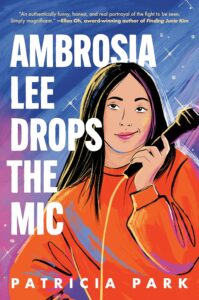
 With two critically-acclaimed YA novels under her belt—Imposter Syndrome and Other Confessions of Alejandra Kim and What’s Eating Jackie Oh—Patricia Park releases a hilarious new YA novel, Ambrosia Lee Drops the Mic (Crown Books, April 28, 2026). This heartwarming story features a Korean-American former child actress who decides to branch out and stand out in order to pursue her newfound love—stand-up comedy.
Praise is pouring in for Ambrosia Lee. A starred review from Kirkus says it’s “an inspirational, funny, and charming story infused with agency and moxie.” Publisher’s Weekly’s calls it “a funny, absorbing, and empowering tale of one teen’s embracing truth and integrity over artifice and popularity.” Booklist agrees: “The real star of this story is Ambrosia, who tackles the intense pressure placed upon young women to look skinny and beautiful, the challenges inherent in an often male-centered comedy scene, and the process of seeing your own parents as people with sometimes messy histories.”
Desmond Hall: This is a very, very, funny book. You even share some of Ambrosia’s comedy techniques throughout the story, which are as instructive as they are hilarious. Can you tell us how you learned those techniques?
Patricia Park: I went “method” and studied stand-up comedy to research Ambrosia Lee. I learned “comedy techniques” by bombing onstage—a lot—and studying my tapes after. As a novelist, it’s weird to get swift feedback in real time; in our world, it takes years before you get roasted in a Goodreads review. Each time I made a fool of myself onstage, I thought, I’m suffering for the art, lol.
Most books feature a dramatic arc punctuated with moments of comic relief, you give us a fun, free-wheeling experience punctuated with moments of emotional depth. Did you plot this out or did it come to you during the writing?
I only started with the character and the premise: a failed child actor ages out of Hollywood roles and finds her voice doing stand-up comedy. I wasn’t sure where her story was going when I started out—unlike with my other novels (e.g., Re Jane, a retelling of Brontë’s Jane Eyre), where I did plot out the dramatic arcs. I think Ambrosia’s arc came together only once I was immersed in the stand-up world and, well, I got heckled a lot! Some comics would pick on me and make jokes about my race and/or gender. It wouldn’t call it a barrel of laughs. But my “comedy trauma” (traumedy?) did help shape Ambrosia’s journey as an aspiring stand-up.
The book gives us a look into the workings of Hollywood and the teen-acting world. How did you go about researching that? By the way, it was done so well I had to look you up to see if you were a teen star yourself.
Ha! You flatter me, but we both know there were no casting calls for Asian kids in the 90s. (Don’t get me started on Karate Kid!) I was doing research for my previous YA, What’s Eating Jackie Oh?, which was set on a competitive TV cooking show, and I interviewed TV production people, including a teen contestant on a cooking show. I fell down the rabbit hole of researching child actors, and the research from one novel bled into the next. There are even cameos of Hollywood “characters” from one novel to the next.
There’s some great business in the book about how celebrity culture can lead to body issues. Can you talk some more about that?
Ambrosia and her talent agent “joke” that Ambrosia either needs to “drop 20 or gain 100.” And she’s still just a teenager! Girls and women in the public eye face enormous scrutiny. And add child actors to the mix, and it’s downright creepy.
You’ve created a world where the celebrity cliques are vicious and somehow fun and hilarious at the same time. Was that a difficult balancing act?
Sadly, I just drew from two experiences you and I are intimately familiar with: high school and literary cocktail parties. You know, that feeling where you’re walking past the cool seniors by the lockers or a clique of writers published in the New Yorker, and you just feel like the biggest, most invisible loser? Yeah, fun times. As a humorist, I can take those cringey, humiliating experiences and write them as satire. Hopefully by normalizing these awkward high school moments, it’s like saying, okay, this too shall pass.
Ambrosia’s arc is a full one. You put her in trouble and heighten the stakes and force her to make some very serious choices. I’m curious about the process you used to make this happen.
All I knew going in was that if I made Ambrosia’s goal too easy, then the story would feel unsatisfying. Readers want the ending to feel earned. My novels are intergenerational—Ambrosia’s parents play a big role in the novel—so I wanted to make the crashing climax be professional (acting vs. comedy), emotional (will she get the boy? which boy??), and familial (how will things shake out with Mom and Dad, vis-à-vis their divorce)? The tricky thing was getting the timing and pacing so the various storylines all crested at the same time, so I guess it was a lot of cut, paste, and delete. My outtakes file is 10x the size of the finished novel, so go figure.
I know you’re always busy, so I have to ask what’s next?
I have some half-finished novels I’m itching to get back to. More details (hopefully?) TK!
Patricia Park is the author of the award-winning novel, Re Jane (a Korean American retelling of Brontë’s Jane Eyre), and the YA novels Imposter Syndrome & Other Confessions of Alejandra Kim (an NPR Best Books of 2023 and a Gotham Book Prize finalist), and What’s Eating Jackie Oh? (Kirkus Reviews’ Best YA Books of 2024. She is a tenured professor of creative writing at American University, a Fulbright scholar, an Edith Wharton Writer-in-Residence, a Jerome Hill Artist Fellow, and other awards. She has written for The New York Times, New Yorker, Guardian, and others. Patricia was born and raised in Queens, NY.