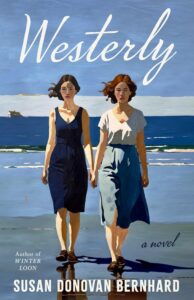
 Susan Donovan Bernhard’s second novel, Westerly, traces the lives of three women over a period of fifty years, across coastlines and bloodlines. But despite its epic scope, this novel never loses sight of the intimate story at its heart: one family formed, expanded, broken, lost, and found again. In 1946, Gisela arrives on the Atlantic coast of Ireland with her younger sister Elizabeth—German refugees, orphaned by war and relocated to foster families through the Operation Shamrock program. After gradually learning to love her new life in Ireland, Gisela experiences another tragedy that leads her to an astonishing decision: to abandon her sister and begin her life over again in America with Thomas and Jean, a couple grieving the loss of their only daughter. Now “Faye,” the German war orphan becomes an Irish-American girl, meets and marries her Irish-American husband William, and tries to forget the past—until it comes knocking in the form of Conor O’Kane, an “old friend” from Ireland who knows Faye’s darkest secrets.
Over the years, O’Kane casts a sinister shadow over Faye’s quiet life, and eventually over the lives of her daughters, Maeve and Molly. When tensions finally erupt on Maeve’s prom night, Molly takes action that will send her spiraling down a path of self-destruction and threaten to break apart everything Faye has built. A story in which secrets bind just as strongly as blood, Westerly is a generation- and ocean-spanning novel, set largely on the coast of Maine but with Ireland always looming on the far shore.
This was one of those truly special reads that stuck with me well after the last page, which is why I urge you to pick up a copy of Westerly as soon as you can. Read on for my fascinating conversation with the author.
HP: Can you talk about the spark that made you think, “I have to write this story?” How did your own family history help inspire this novel? And how did you first learn about Operation Shamrock?
SDB: I was on a trip to Ireland in 2019 visiting family. We got turned around in the Wicklow Mountains and ended up at a place called The Glencree Center for Peace and Reconciliation. It was a quick stop. My husband and son went into a café there to get water and I saw a plaque on the wall that described the history of the stone barracks that made up most of the buildings. That’s the first time I ever heard of Operation Shamrock. By the time we arrived at the trailhead only about 14km away for a planned hike, two little German girls had taken up residence in my imagination. I could see them stepping off a bus, shocked by this green place so undisturbed by the war that had plagued their own lives for years. While my husband and son went on the hike, I sat in our rental car by the side of the road and wrote the first scene for what would become Westerly. Originally, it was tacked onto a different novel I was struggling to make work. Eventually, I dropped other storylines and concentrated on these little German sisters and a girl called Nola Wren who I had pictured standing on the rocky Maine shore, staring across the Atlantic as if she might be able to see Ireland.
As far as family goes, while I was working on Westerly, I also obtained Irish citizenship through my grandparents on my father’s side. My husband was born in Germany and adopted by Americans, but his birth father lives in Ireland now. On that same trip to Ireland, we also visited my grandmother’s birthplace on Sheep’s Head Peninsula which became the Irish setting for Westerly. So, while the novel is complete fiction, it’s definitely informed by real places and events.
Your writing style has so much in common with many great modern Irish writers – that balance of lyricism and spareness that you find in Colm Tóibín or Claire Keegan. Did you read a lot of Irish writers to prepare for this story, or do you have favorites that you go back to again and again?
Oh! Please! Compare me to more of my favorite authors! Seriously, what an amazing compliment. This might sound cheeky but this is really the way I write. I will admit to sometimes venturing into purple prose territory but I like to bring it back down with a punch so that’s probably some of the parallels that you are picking up on. I am a huge fan of Anne Enright and loved her novel The Green Road. I looked at her structure there quite a bit, how she moved POV to the stories of each of the Madigan children then brought everything back together in the final chapters. I also really admire Trespasses by Louise Kennedy for the writing, of course, and for the chronological storytelling which felt like such a relief after reading a lot of novels that jump back and forth in time. I’d originally thought that Westerly would be more like the television show “This Is Us” in the way that it moves back and forth in time. But either the story didn’t lend itself to that complication or I wasn’t up to the task.
In my opinion, the linear chronology serves this story well! You can really appreciate how the characters grow and change over time. I was particularly struck by how each character’s point-of-view feels distinct, but without working against the unifying force of the narrative. It never feels choppy, or like bouncing from one novel to another. How did the voice of the novel change as it moved between points of view—and how did you keep it consistent across decades of the characters’ lives?
I’m so glad that worked for you. If I got it right, it’s because I truly tried to keep focused on each character’s primary wound and how their wants branched out from there. Faye, of course, ages the most in Westerly and the generational influence helps to keep her voice distinct from both Maeve and Molly. But I think too that, because Maeve and Molly are so many years apart it was a little easier to give them distinct voices.
There are several moments within this novel where characters make decisions of momentous consequence, sometimes even defying our expectations as readers: in particular, when Faye decides to abandon her sister. How did you approach these moments? Were you afraid of “going too far?”
This is such an interesting question and one that I’ve actually thought about for other reasons. I knew from very early in the process that the sisters would be separated and that one would go on to live in America. And I knew that Faye would be complicit in that decision. What I had to work through over many drafts was how a child might see her circumstances differently than an adult would. Specifically, how this child perceived her options and to make sure that she continued to be a person who would have made that kind of decision. I also worked really hard to make it so the reader could ultimately come to see how a child might make a questionable choice without faulting her.
When my kids were younger and they hit rough patches, I would remind them that the circumstances they were in were not permanent, that they were going through something, not stuck in that same something. Adults have lived experiences and we learn from every victory and every heartbreak. For children, each new moment feels exquisite and sharp. As a child, Faye experienced war and suffering and death up close. Her response to that was to insulate herself, to try to keep herself safe. But Faye, as a child, couldn’t understand her own trauma response. Children are rarely if ever that self-aware. So when Molly experienced a trauma, Faye’s response as her mother was to protect her daughter with the same silence she’d used to protect herself. Same with Maeve. A terrible thing happened to the Sullivan family in a single night and—as a woman who was not introspective, who had not come to terms with her own trauma, who had not owned up to her secrecy—the only way Faye could respond was to insist that everyone pretend, suppress, and keep silent about the circumstances. Eventually, that pressure has to go somewhere. Either the roof blows or the walls come down.
Having grown up in an Irish American family, many things about the Sullivans and their extended family felt familiar to me, in particular the strong ties they maintained to the Old Country. You have Conor O’Kane’s involvement in the Troubles, Thomas’s stalwart clinging to Irish culture via The Irish Times and memorized poetry, and Jean’s often silent grief for everything she’d lost and left behind. What part does Ireland play in this story, even when it’s an ocean away? And for that matter, what part does Germany play?
My grandparents on both sides were immigrants—my mom’s parents came from Germany and my dad’s from Ireland. But in my big family—I have five siblings—we really were our father’s children and identified more as Irish than German. I think even my mom wished she was Irish. We never really talked about or embraced the German side of our heritage. The Irish blessing hung by our front door. We had shamrock plants in the kitchen, Belleek china in the cabinet, and a blackthorn shillelagh hanging on the wall. I can’t recall a thing in my house that pointed to our German side other than my little grandma who lived with us for a while when I was a child. Maybe it’s the patriarchy. For sure, my dad was an outsized character, well-known in the small town where I grew up and where he taught high school math. We were all our father’s children and my mom was my father’s wife (and happy to be viewed that way, I might add). In some ways, I used my own parents as a model for Faye and Wiliam. My father served in France and Germany during WWII then came home and married a German girl. I never had the presence of mind to ask either of them with any depth how WWII affected them.
For Thomas, Jean, and Faye, Ireland represents loss and yearning and, as much as each of them might try, it’s never far from their minds or memory. But for William, Ireland was more an ideal and I think that’s how it was for my father and so many Irish Americans before travel became accessible. I struggle on the German part since I have German relatives and friends but I do think there is a certain sense of shame that lingers even all these years. I feel it even answering this question like I’m suggesting that anyone with German roots bears responsibility for the atrocities of WWII. I definitely considered what William might have made of the secret that Faye kept. I like to believe it wouldn’t have mattered to him. But I do think that Faye was right—the deception would have hurt him the most.
This book features a wonderfully despicable villain in Conor O’Kane. I mean, he really makes your skin crawl whenever he shows up! What was your process in constructing this character? And I should add, it felt important to me that this character was a man facing off against the three women at the heart of the story. How did that gender dynamic come into play?
When I was a little girl, my dad had a friend of sorts named Denis O’Brien who became kind of lore in our family. I don’t know how they knew each other and I can’t recall much about his appearance other than a black leather jacket and maybe dark hair. But I’ve never forgotten one night when he appeared at our house, how threatening and ominous he seemed. The rumor was that he was in the IRA. During a particularly complicated period in my family history, (again) rumor has it that my dad might have taken a hit out on a man he perceived as an enemy, with this Denis O’Brien as the would-be assassin. If that’s true, my mom probably talked him out of it or my dad sobered up. Regardless, the guy wasn’t gunned down. In my mind, Conor O’Kane is a cross between Denis O’Brien and Arnold Friend, the villain of the Joyce Carol Oates short story, “Where Are You Going, Where Have You Been?” The other thing with Conor, though, is that I did want to make sure his core wound was on the page. The reader doesn’t have to like him, of course, but I do hope it’s clear that he loved Fiadh and believed that she’d shunned him only to find out later that her disappearance was part of a larger treachery, and that his own mother disowned him. And yes, he’s sure a bully when it comes to women but much more obsequious around other men. Such a tough guy.
There’s an almost ghostly element to this story, as the’ living characters are often haunted by the dead—not literally of course, but in the sense that these ghosts hold onto the characters’ darkest secrets, and seem to be forever on the point of being unburied. Can you talk about this interplay between the living and the dead?
My former editor Hafizah Geter suggested a book to me some years ago called Ghostly Matters by Avery Gordon. It’s quite academic and frankly, a lot of it went over my head. But there was a fundamental idea that cultural and social forces plus lived traumas can haunt a person beyond the traditional sense tied to superstition or psychosis or spirituality. Faye and Molly are definitely haunted by the ghosts of their past, by their history and their actions; Thomas and William, too. Maeve—the most practical and I would argue the most self-centered of the POV characters in a way—doesn’t dare dip into her emotions for fear of what’s hiding there. At one point, Wendy suggests to Maeve that Molly must be completely traumatized by what happened to her and Maeve glosses it over, unwilling to engage with that family secret.
Over the long years of crafting Westerly, I’d toyed with the idea of having one of the POVs actually be a dead girl as an omniscient voice. A tiny bit of that still lingers in the novel and, ha! no one made me take it out! Truth about the ending of the novel: Lissa Franz, my dear friend, fellow Incubee, and one of my most trusted readers, suggested I take out the (former) last line of the novel that was a vestige of that omniscient voice, a sense of a ghost finally being laid to rest. She was absolutely right about that and the ending is stronger for her note. That was a darling that needed to be killed off, a ghost that didn’t need to have the last word.
Westerly is full of richly developed romantic relationships, and among them, there’s a queer coming-of-age story set within a particularly tumultuous era to be discovering yourself as LGBTQ+. How did you approach that story, from Maeve’s point-of-view, but also from the characters around her?
In Westerly, on a terrible night for the Sullivan family, Faye essentially shoves her teenaged daughter Maeve back into a closet from which she was barely emerging. (Oh! I just realized that Faye was “shoving” Maeve as Molly was shoving O’Kane!) Instead of owning up to her fear of what it would mean for Maeve to be gay, Faye offloads her fear onto Maeve’s father William, suggesting that he would be the one disappointed. That word: “disappointed.” Sigh. And Maeve—her father’s ray of sunshine—falls for it. As much as that reeks of homophobia, I think it was an honest response for the time from Faye. So many parents—and I include myself here—harbor an intense fear when it comes to their children’s safety. I wanted my kids to live well within the lines of social acceptance so their lives would be “easy” as if there’s some sort of “easy way” button you can just push. Given that safety is what Faye wants most for herself and her family, it’s no wonder that she tried to silence her daughters in the same way that she kept her own secrets and shame quiet.
When I first started building the character of Maeve, I imagined a path for her that would lead to (spoiler alert) happiness. I had a friend in high school named Marla. Everyone loved Marla, wanted to be close to her, wanted to be her, even. This was the early 1980s and Marla was a star basketball player, a “tomboy,” and utterly cool. We kids were shockingly obtuse and cruel back then, ridiculing and mocking girls who were drawn into Marla’s orbit. Surely some of those girls were attracted to Marla more than they were to any boy. Surely some experienced the confusion of desire even if they couldn’t quite name it. There was just something about Marla. She and her twin sister Joni, a literal beauty queen, were both incredibly charismatic. But no one, not even the most popular kids, comes out of high school unscathed. At a class reunion in 1992, I talked to Marla about my life. I was living in San Francisco at the time, dating a guy who would eventually be my husband. Marla had come out by then and brought the woman she was dating to the reunion. We talked about San Francisco, what a great city it was, how open and adventurous and artistic and wild. I think that was the last time I saw her. Marla carried the kind of pain that ultimately led to her taking her own life. I was heartbroken by the news of her death.
When it came time to write the character of Maeve, I imagined Marla, confronting the demons that haunted her and coming out on the other side of the fight very much alive.
One of the most fascinating characters in this book, for me at least, was Molly, who starts out in life as one person and then suffers a trauma that sends her shooting down another path entirely. She goes through an incredibly dark journey, but I never stopped rooting for her. How did you go about creating her? Were you thinking about the end even at the beginning, or did it all come together intuitively?
I’m so glad you were rooting for Molly. I was, too. I knew very early on how Molly’s journey would end. Getting her there was less clear and took several turns to get right. I actually had a key reader suggest Molly could simply “get over” the childhood trauma she experienced as a result of the secret her mother kept. Like, what was the big deal anyway? I was honestly shocked by that comment. And then, a cultural sensitivity reader suggested that Molly would need therapy (within the narrative) to even survive what she had experienced. I’m sure Molly would have benefited from therapy but she was not from a place or time or people, for that matter, who might have offered that. How did two readers have such a different take on Molly?
The Kirkus review for my first novel Winter Loon, was terrible. The reviewer wrote, “Living with the pain caused by other people in pain, the protagonist has a resilience that’s almost beyond belief—really, it is hard to believe,” as if no one can survive adversity. The reviewer went on to suggest that it would be impossible for the character of Wes to even function. “Against this emotional backdrop and with no supportive authority to guide him, Wes somehow attends high school, holds a summer job, and falls in love.” I sure hope that person doesn’t read Westerly because they probably won’t love that Molly has to embark on a real and true journey of self-loathing to get to forgiveness—for herself mostly but for and from Maeve and Faye, too. Personally, I like a flawed character and I loved these women and their scars and the way they kept facing into the wind.
I am so glad you stuck to your original vision of her, and that you didn’t let a bad review get in your head! You write about survivors, and clearly, this is a book about women who survive, whatever it takes. It’s also about family—not just in terms of bloodlines, but other bonds as well—and the many ways in which families are made and might fall apart. Could you talk a little about how this theme works within the novel? What was it about the idea of family that grabbed you, even going back to the history of the children of Operation Shamrock?
The stories of the children of Operation Shamrock are fascinating. I was amazed at how different their experiences were—from the quality of the foster experiences, to how their birth families reacted to their leaving and returning, to how they’ve come to see their history. Stunning. There’s a scene in Westerly where Faye sees a book about the children of war and, to me, it’s one of the hearts of the novel. I don’t think we can even begin to understand what war does—I don’t pretend to understand but I have deep sorrow for the children experiencing war right at this moment. Fiction allowed me to explore how these two little German girls might have experienced the same trauma differently, how they might see the world differently, and how they might want different things—how one might cling and the other might flee. By extension, then, William brings his experience of war to his family, Thomas and Jean bring displacement and loss, Maeve and Molly inherit and experience trauma differently, and all of them search and search for acceptance and understanding wherever they might find it over the course of five decades. There’s a great line from The World According to Garp that’s been stuck in my head for years. I had to Google it to get it right. I think this is it: “The history of a city was like the history of a family—there is closeness and even affection, but death eventually separates everyone from each other. It is only the vividness of memory that keeps the dead alive forever; a writer’s job is to imagine everything so personally that the fiction is as vivid as our personal memories.” I hope that I’ve done my job, imagined the closeness and the rifts and the reconciliations vividly so that this fiction represents some truth as well.
Without giving too much away, how did you approach the ending? There were so many ways this could have gone, but I felt like where you ended up was at a point where all the characters are given yet another opportunity for growth and change, which of course we only get to imagine. It feels generational, like a story that could continue on forever, following this one family into the future. Is that the effect you were aiming for?
John Irving (again) famously writes the ending of his novels first, apparently often before he writes anything else at all. I always knew what the ending would be but I had no clear path to getting there. I won’t spoil it either but Molly says something at the end of the novel that serves as a bookend with the beginning that didn’t come to me until the final round of edits before the novel went to production. It took that long for me to understand the life cycles these generations of women were experiencing, how Faye, her daughters Maeve and Molly, and Molly’s daughter Nola Wren were like the Three Fates—Mother, Maiden, Crone—and how Faye’s original wound set their course. I saw a meme the other day of generations of women passing a heavy rock to each other, a burden for each generation to bear. When the youngest woman accepts the boulder from presumably her mother, she holds it and, rather than passing it on to a young girl, she sighs, sets it down and places a floral wreath on the girl’s head instead. It was a simplistic representation of generational trauma but I appreciated it nonetheless. It takes recognizing and naming the burden in order to set it down.
Thank you so much for taking the time to answer all my questions about this wonderful novel. I’m wishing you tons of success!
Susan Donovan Bernhard is the bestselling author of the novels Westerly and Winter Loon, which won the Boston Authors Club Julia Ward Howe Prize for Fiction. She is a Massachusetts Cultural Council fellowship recipient, a GrubStreet Novel Incubator program graduate, and a Tennessee Williams Scholar to the Sewanee Writers’ Conference. A dual citizen of the United States and Ireland, Susan was born and raised in the Bitterroot Valley of western Montana and graduated from the University of Maryland. When she’s not traveling, she lives and writes in Massachusetts.