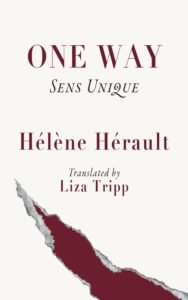
 One Way (Silent Clamor Press), by Hélène Hérault, translated by Liza Tripp, is a compelling, noirish novella built around a one-way correspondence between Béatrice and the husband she left. Used to being in control, he has no way to respond as Béatrice assumes control of the conversation, making him a captive audience for her increasingly disturbing memories and accusations. Written in stark, minimal prose, the tension mounts as this powerful story unfolds and veers toward its startling conclusion.
I was delighted to speak with Liza about her career as a translator and the challenges and rewards of translating One Way.
Emily: What made you choose to translate this book?
Liza: A series of random events! I had recently decided to fully pivot to literary translation and was looking to pitch directly to publishers, when I noticed that The American Literary Translators Association (ALTA) was doing a speed-dating-type pitch session. I saw they did poetry, and I love poetry. I also knew I could translate poetry, and that not everyone could. I had three weeks before the pitch, so I set about trying to find some poets to translate. I found an article about Rim Battal in French Vogue calling her part of “a new generation of poets.” So I ordered her L’eau de bain right away, along with a few other collections. Then I realized there was no way any of it would arrive on time for this pitch session, so I started looking at French online literary journals.
That’s where I found Pro/p(r)ose Magazine, and right there on the front page was this poem “The Decision” by Hélène Hérault. It had this very modern, musical style and a bit of a surprise ending. Sound is such an essential part of poetry, and it’s so often something that I find translators miss, because it can be really tricky to preserve meaning, while also conveying the music of the original. Anyhow, this editor (who I now know pretty well) politely told me it was not their style and also suggested I get to know their publication a lot better (it was good advice!). But now I had a poem, so I started sending it out.
A few weeks later, Cordite Poetry Review accepted it for publication, and asked for a few more. I was already in contact with Hélène, because the first thing you need to do if you want to translate anything is figure out who has the rights, and then get permission to translate it from the rightsholder. It was funny, because apparently when the editor of Pro/p(r)ose told Hélène that someone wanted to translate her poem, she thought it was a joke and initially ignored it! Hélène has won a few prizes and has had many of her poems published in France, but she is not super famous, and it’s rare to be translated into English at all (although some of that is now happily changing). But just to give you some context, the last statistic I saw was that only 3% of the books published in the U.S. are in translation. That’s way lower than most other countries (which means we are truly missing out on a lot by the way). Anyhow, I just really liked translating Hélène’s poems, so I asked what else she was holding, and one of the things she sent was her novella Sens Unique (One Way).
What else can you tell us about the author, Hélène Hérault and how you worked with her?
Hélène has written her whole life but only began publishing her work in 2017. Prior to that, she worked as an actual meteorologist(!) for 40 years with the French national weather service and for 10 years was then deputy director of the French national meteorologists union. The fact that she was new to publishing probably made her work a tough sell, but I believed the writing stood on its own merit. What’s good is just good, and I think it’s telling that the first texts I was able to successfully pitch were by Hélène.
Hélène and I discussed the translation after it was finished. In translation, you really need to rebuild the work from the ground up, and at least initially, that process is best accomplished independently. At the end, there’s always a list of questions, and at that point you can ask them. Hélène and I work really well together, and we love to talk about language. Sometimes she gets frustrated that not everything in French will work in the same way in English, but it’s funny, there are a few cases where I probably would have just stopped, and because she wasn’t satisfied, I ended up finding something much better. There’s always a solution if you can think creatively.
Can you share some of the challenges of translation in general, and specific ones for this book?
Everything is translatable, but there is always loss and gain. I always think of this quote by Roman Jakobson “Languages differ not in what they may convey but in what they must convey.” The words we choose often point to more than one thing. So once you decide what a foreign word means, something along the lines of, “oh yes, the author means definition 3 when she uses word “x”, that’s in a sense where the translation process begins. Because at the same time that a word can be pointing very concretely to a given definition, it’s also leaving space for adjacent definitions. We hear a lot about nuance these days (“AI can’t translate nuance,” for example—and that’s true!) but most people’s understanding of the process is still stopping at the surface level. But really the words are all functioning in a more fluid state. So when we choose, say, “definition 3” we might also be invoking definitions 1, 2, and 5.
There’s a book by theater professor Marvin Carlson in which he talks about the phenomenon of “ghosting,” the idea that actors’ previous roles haunt their new performances. It’s kind of like how you can’t help but see Julia Roberts as the girl in Pretty Woman when you watch her in Ocean’s Eleven. I often think about this in translation—that each word carries its ghosts. Here’s an example from One Way. Early on in the novella, Béatrice talks about Gaëtan’s “collaborateurs et collaboratrices.” The word “collaborateur” and its feminine form “collaboratrice” can be read as just a colleague, a co-worker, or an employee. But this is also the word you use in the sense of “collaborators” in World War II. So Béatrice is already alluding to how Gaëtan’s employees and coworkers are, to varying degrees, under his control, and in many cases complicit.
Here’s the full sentence in English: “Above all, don’t try to find out how you received this letter; your associates and partners (note the wording) will be useless here.” I eventually ended up with “associates and partners” because it doesn’t pin down the English. The idea of collusion is not as obvious in English as in the French, but we’ll actually see these words (and similar words) again, so over time and with repetition, a similar effect begins to occur in English. You can’t always translate the same word the same way of course, but I do think that it’s important to understand when something more systematic is going on in the words, and how that might be helping to underpin the text. Once you see it, you can find a solution.
What was your biggest or most interesting challenge in translating this novel?
The biggest challenge by far was recreating Hélène’s style in English. Here, you need to understand a few things about language to get the idea. First, every language has its constraints – these can be grammatical, syntactical, stylistic, you name it, but every language functions differently. In French, you can have very long sentences (sometimes one that even takes up the whole page) and you can have split infinitives, and you can have fragments, and somehow this doesn’t really impact how easy the thing is to read. It makes perfect sense in French, and has that added artistic benefit of being something flowy and undefined, impressionistic almost. If you transpose all of this into English (and believe me, the temptation is real!) you get something that’s really hard to read and understand, and that sounds muddled, like the thoughts of a crazy person. Yet Béatrice, while having suffered her share of abuse, is in complete control of her faculties. So there are times where you can let the style of the language peek through and sometimes that can serve the themes of the text, but not here.
I had to break up those long sentences, and I had to finish some of the fragments. But I still wanted people to hear that rhythm and flow of the French, and also it’s pacing. Béatrice is taking her time, but there’s a crescendo in there, and I wanted you to feel that. The text also has these noir elements, but they are softer than in some of the English language noir I’ve read. That might be because of the language itself, of how you can leave things a bit undefined, but it’s also a function of Hélène’s own style. So I wanted to give you a feel for the noir style of this particular French text, but in English.
This book is structured as one way correspondence between a woman and the husband she has left. While we also get glimpses of him from a few other POV characters, I believe we never hear from him and he never gets to defend himself. Can you talk about the significance of this structure and how you approached it as a translator?
This is the very essence of the book. First of all, there’s no reason to hear from him, because he’s already done and said enough. But we do get glimpses of his reactions through the letters and through things the other characters say, once we hear from them in Part II. Yet the whole idea is that we don’t really need to hear from him, because he’s entirely predictable. Béatrice robs him of his voice, but we still know what he’ll say—he’s reduced to a pathetic ghost. Also essential is that it’s not a “moral book” but a noir. So there is no attempt to cast Béatrice’s actions as right or wrong. Even the ending avoids pinning things down entirely.
In translation, you have to decide what things mean, and then try to reproduce the delivery. Kind of like an actor who needs to decide what a character is feeling, what the real backstory is, but then goes on stage and can only say the lines—which obviously won’t include all that backstory. With this novella, I tried to recreate that moody noir atmosphere. Doing that in translation basically entails everything that the writing process does, but with the constraint of writing in a different language. So here it meant picking words that suited the mood, that aren’t too pinned down, writing sentences that could duplicate that flowy quality of the French, while also making sure that Béatrice’s anger came through. Because she’s angry and fed up, but never hysterical, and always lucid.
What drew you to become a translator? Any fun experiences you’d like to share?
So many. The quick answer to your question is that I majored in French, and you had to choose a concentration. Translation always clicked for me. My year abroad, I continued to study it, although I actually always thought I wanted to become a pastry chef. I loved to cook and I worked in restaurants all through college (front of the house, and then some kitchen experience towards the end). After college, I enrolled in pastry school. I actually cut off a ¼ inch of my ring finger on the first day, so maybe that was a bad sign. I ended up leaving “after chocolate and before wedding cakes.”
Translation was the other thing I knew how to do (although at the time not well!). I wrote a million letters and it turned out that there was a translation agency across from where I was living. They interviewed me even though they didn’t have any openings. A few weeks later, someone left, and I had a job translating documents from French, Spanish, Italian, and Portuguese into English. Later I did the translation program at NYU-SCPS, which taught me about all kinds of very specific types of translation (legal, technical, financial, etc.) But I still didn’t think I could support myself as a freelancer, so I enrolled in a doctoral program at the CUNY Graduate Center, where I studied French literature and translation theory. Eventually I had a pretty busy freelance career, and then three kids (I was always pregnant at every doctoral review!), and then my dad was diagnosed with a brain tumor, so I let the PhD go. By that time, I was mainly translating for the litigation and luxury fashion sectors, and I had started to translate those big, beautiful coffee table books. Those books are what eventually led me to pivot entirely to literature and poetry.
I have some great translation and interpreting stories. For example, I’ve interpreted for a super hands-on leasing agent in midtown Manhattan for most of my career. Whenever the owners come to tour the building, we go everywhere—an incredibly hot boiler room, the kitchen of the fancy ground floor restaurant, and even the roof.
Everyone always assumes document translation is boring, but often it was very exciting, especially working in litigation. Sometimes a judge would order that the whole record be translated, and we’d be translating the full contents of hard drives—emails, you name it—in fact I’m not allowed to say anything more! I also loved the fashion work—fashion is so much more technical than most people realize, especially at the luxury level, and it ties really closely to art, history, and culture, and a lot of that is marked within the words used to describe it.
What do you feel the impact of AI is or will be on book translation?
I’m sick of AI. I want more humans in my life in general. As someone who has worked with computer-assisted translation tools, and post-edited machine output, I know that even these new models are tools. Their success depends on who uses them and how much that person knows. For translators, the biggest danger right now with the LLMs is that they produce very fluent-sounding (albeit totally blah) translations, but they contain errors, and I think we’ll need to train a new generation of translators who know enough to find the errors. Also, they make everything sound the same, and that’s a shame. In fact, I think the flat sound is already becoming a problem for people in certain industries, because how can you differentiate your company if your copy sounds exactly like your competitor’s? The biggest secret weapon we all have right now is to hold on to our brains and our individual way of expressing things.
In book translation, I think that AI has absolutely no place in the writing process, no more so than it should in the writing of books in the source language. Anyone who uses it to write (because, again, that’s what translation is—writing with constraints) is robbing themselves of everything that goes into producing a quality piece of writing. Because there are no shortcuts in good writing. And what translators know, that maybe other people do not, is that when someone reads a poor translation, they’re not going to say “oh that must have been done by AI,” or “they must have had a bad translator,” they’re just going to say “I hated that book.” Sure, AI can be helpful in research, in pulling lots of examples of something, which you can then verify and analyze, or even in tracing the etymology of a difficult slang word, but the human must do the translating, the writing. I think because good translation was for so long synonymous with being invisible (translators’ names were often not on the covers, for example, until recently), many people think of it as this automated, replaceable thing.
It’s a hot topic of conversation, and since you’re a translator have to ask, what are your thoughts on Christopher Nolan’s The Odyssey?
I’m no classicist, so I’m going to skip this one, except to say I love all the attention it’s called to the translation process–people are considering topics of translation they never thought of and having these aha moments. It’s cool, and Emily Wilson is cool! (which is why I’ll leave The Odyssey questions to her).
Tell us about your translation of Rim Battal’s I’ll Look Myself in the Eyes, coming from Galiot Press in November 2026.
I’ll Look Myself in the Eyes is an autobiographical novel by Moroccan poet and novelist Rim Battal. I found out about Rim after I botched the ALTA speed pitch process, and I’ll be forever grateful for the mistake. In addition to getting Hélène’s work published, I was able to successfully pitch Rim’s novel to Galiot, and I was also recently awarded a Villa Albertine (French Embassy) translation grant for Rim’s poetry collection Bathwater [L’eau de bain]–by the way, we’re currently looking for a publisher in case anyone out there is interested.
I’ll Look Myself in the Eyes is the story of 17-year-old Rim whose mother catches her smoking out her window one day and severely beats her. Rim decides to hop a train to her aunt’s house in Casablanca. She figures she’ll spend a few nights there until her more modern aunt talks some sense into her mother, and then go home. Instead her aunt delivers the news that if she wants to go home, she’ll need to undergo a gynecological virginity test. It’s about the ways intelligent women who should know better end up complicit with patriarchal systems. It’s also a funny, coming-of-age story. I was immediately struck by how relevant it is to all women, regardless of country. How many of us in the U.S. have found ourselves agreeing to all manner of bizarre, unfair things in service of patriarchal values that really shouldn’t exist anymore?
Liza Tripp is a translator based in Centerport, NY and Rockport, MA. In addition to One Way, she has also translated Rim Battal’s I’ll Look Myself in the Eyes (Galiot Press) and received a 2026 Villa Albertine translation grant for Rim Battal’s Eau de Bain. Liza has also translated numerous non-fiction books for publishers including Rizzoli, Assouline, and Schiffer Books. Her poetry translations have appeared in the Cordite Poetry Review and the International Poetry Review.

